In recent months, on behalf of the Department of Innovation and Strategy of the Tax Administration, we interviewed eleven leading experts about the question: what does agentic AI mean for an organization that processes millions of returns annually, makes millions of phone calls and implements complex regulations?
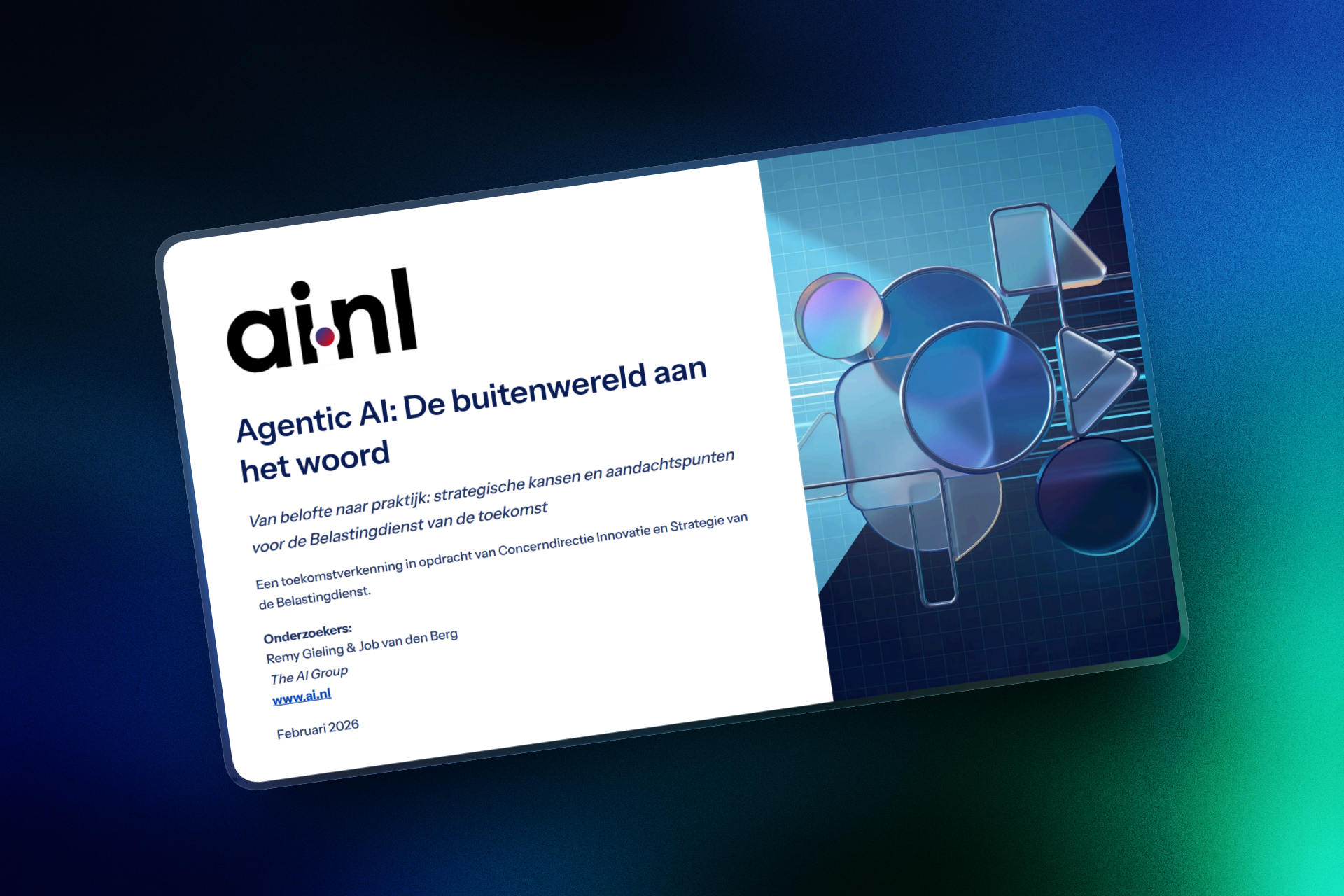
The result is a report that we are publishing today: “Agentic AI: The outside world speaks.” Not a blueprint, but a compass. Below are the most important insights.
The experts at the table
We consciously opted for diversity. The table included Durk Kingma (researcher at Anthropic, previously OpenAI and Google DeepMind), Robert Engels (Head of Gen AI Lab at Capgemini), Deborah Nas (Professor of TU Delft), Sanne Manders (President of Flexport), Winifred Andriessen (VP AI Excellence at KPN), Geert-Jan van der Snoek (CEO Sdu Lefebvre), Jorissa Neutelings (CPN) DO ABN AMRO), Jeroen van Glabbeek (CEO CM.com), Marijn Pijnenborg (co-founder Funda), Bas Haring (philosopher) and Douwe Groenevelt (founder Viridea, former ASML).
Technologists, scientists, administrators and thinkers. That combination proved essential to get past the hype.
The common thread: hype is real, so is the opportunity
One thing stood out in almost every conversation: the warning not to succumb to the marketing machine around AI. Deborah Nas was the most outspoken: in practice, she hardly sees organizations where agents really run operationally in critical processes. Robert Engels called it the “Bermuda Triangle” of agentic AI — the tension between autonomy, agency, and authority. You communicate using natural language with a system that is fundamentally probabilistic. This is great for brainstorming, but risky for processes with legal consequences.
At the same time, Jeroen van Glabbeek nuanced: the hallucination problem a few years ago was largely solved. At CM.com, 85% of help desk queries are handled completely autonomously — with higher customer satisfaction than before.
Art is in the middle ground: neither naive enthusiasm nor paralyzed skepticism, but informed experimentation.
From tools to processes: where the real value lies
The most concrete example came from Sanne Manders at Flexport, which has achieved 51% automation in the core operation. He described three layers of automation: classic software engineering, the “Excel stack” (work that was too variable to automate traditionally), and a new third layer where you tackle that middle layer with LLMs and low-code.
What the tax authorities can learn from this: the greatest value does not lie in chatbots, but in automating processes that now run manually when they don't have to. Flexport now auditions 100% of all customs transactions instead of a sample of a few percent. That fundamentally changes what you can know as an organization.
Man does not disappear, but changes roles
Philosopher Bas Haring told the best example. A man in the municipality of Tilburg, over sixty, helped people write reports. He doesn't do that anymore — AI can do that better. But he has just as much work. Why? Because people want to have coffee with him. They want a person opposite them who listens, thinks along, supports. The same amount of work, but very different work.
This is the key question for every organization: what do you do with the unlocked capacity? The report calls for using them not for greater efficiency, but for better services. The citizen who gets stuck, the entrepreneur with a complex situation, the next of kin who knows no way around — that's what you need people.
The agent as customer: a paradigm shift
Jorissa Neutelings from ABN AMRO sketched perhaps the most far-reaching scenario. What if the citizen no longer comes to the website of the tax authorities themselves, but sends their own AI assistant? She introduced the concept of the “liquid enterprise”: an organization that divides its services into small, connectable blocks that can be queried by both people and machines.
For the tax authorities, this means: you should not only think about how AI improves your processes, but also about how to deal with a world where citizens send an agent instead of calling themselves.
Governance as a foundation, not a brake
The lesson of the childcare allowance affair was reflected in several interviews. Every AI implementation must be designed from day one with logging, audit trails, and explainability. Not as an afterthought, but as a foundation. Geert-Jan van der Snoek from Sdu Lefebvre structurally spends 5 to 6 percent of all development time on reliability and governance.
Robert Engels summarized it succinctly: trust is not built with technology alone, but with transparency, with explainability, with the ability to correct errors.
Seven recommendations
The report concludes with seven concrete recommendations:
- Start with the final image, not with the technology. What does the ideal taxpayer experience look like?
- Start with low-risk experiments to learn. Not primarily to deliver production value, but to understand.
- Invest substantially in AI literacy. Not as a one-off course, but as an ongoing program in all layers.
- Design governance from day one. Logging, audit trails and explainability as a prerequisite for every pilot.
- Keep people at the center where it matters. Use unlocked capacity for better service.
- Stay flexible in technology choices. The toolset changes rapidly — avoid lock-in.
- Create space for innovation “on the side.” A separate team with the freedom to work radically differently.
The conclusion
The eleven experts were completely in agreement on two things. Sitting still is not an option — technology is developing, the private sector is embracing it, citizens will expect similar services. But running blind is not wise either. Success doesn't go to who comes first, but to who learns best.
Or, in the words of Bas Haring: “Piel a little bit. But stick with attention, with reflection, and with the bigger goal in mind.”
The full report “Agentic AI: The outside world speaks” was commissioned by Remy Gieling and Job van den Berg of The AI Group (ai.nl) by Remy Gieling and Job van den Berg of The AI Group (ai.nl). The report is here to download.

.svg)


