
AI Trends
Tesla FSD v13 Explained: How Vision-Based AI Makes Self-Driving Cars Possible

Remy Gieling
February 1, 2026
4
min read
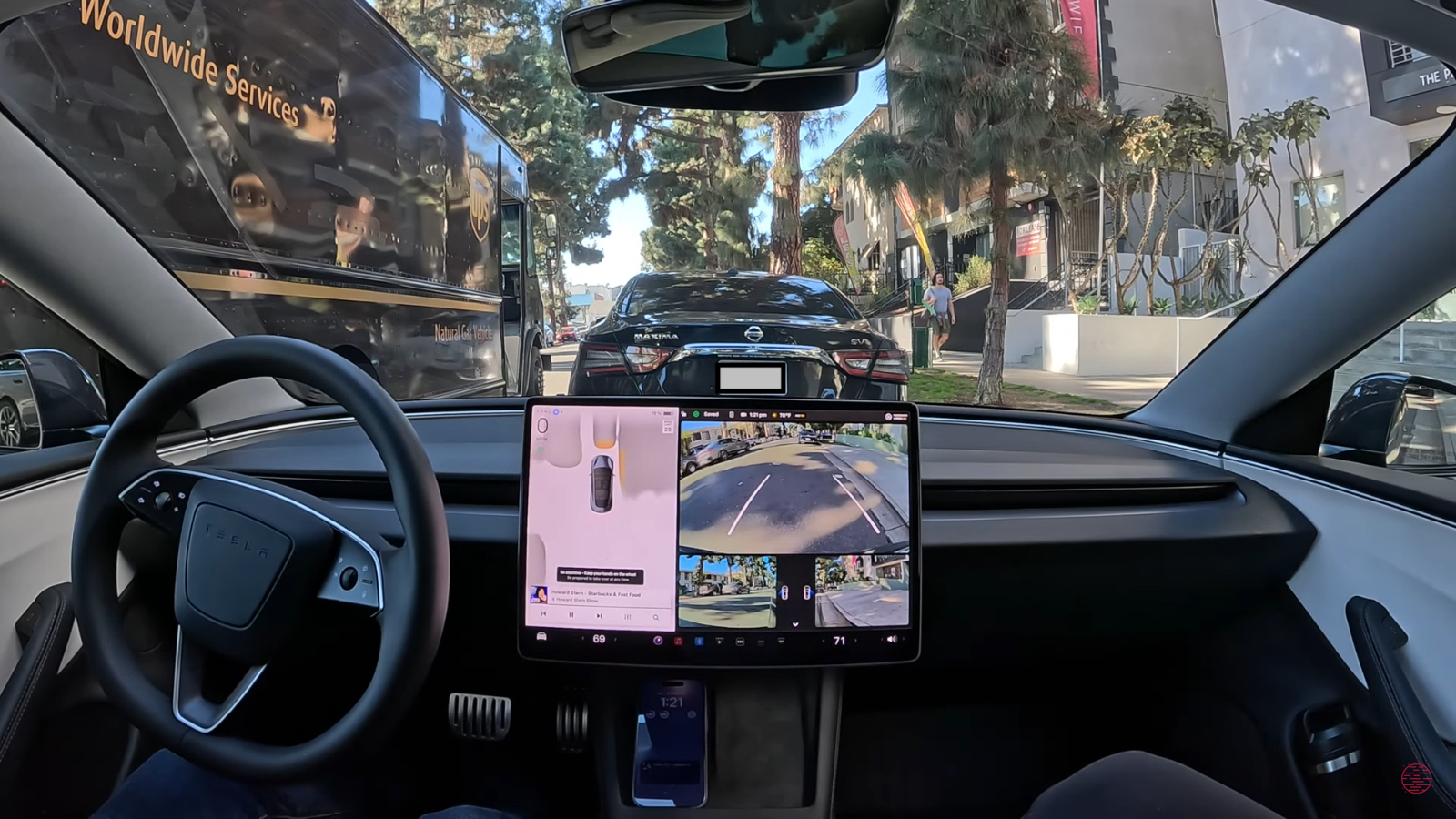
Full Self-Driving v13 is no longer a gadget
After 24 hours of driving Tesla's Full Self-Driving (FSD) v13 in the Bay Area, one thing is clear: autonomous driving is no longer a vision for the future. It's here — but not everywhere yet.
We drove the Tesla Cybertruck from Palo Alto to Santa Clara, across freeways and city roads, through morning sun and evening fog. The goal: not to test the car, but the technology behind it. How far has Tesla's FSD really come?
Tesla's approach to autonomy is fundamentally different from its competitors. Where companies like Waymo, Cruise and Huawei rely on LiDAR, radar and high-definition maps, Tesla is opting for a minimalist route: cameras and neural networks only.
The idea is simple but radical: after all, a person also drives without laser or radar sensors. What we do with eyes and brains, a car must also be able to do with cameras and software.
Elon Musk calls it “vision-based AI” — and that's exactly what FSD is: an attempt to digitally recreate human perception.
In practice, FSD v13 is surprisingly capable. On our trip, the car drove independently for hours, without intervention. He took turns, kept his distance, changed lanes smoothly and recognized traffic lights flawlessly.
The special thing was how natural it felt. The movements were fluid, the reactions more human than ever. No abrupt braking, no doubt at intersections — only the occasional “take-over” message in case of unclear situations.
During quiet rides, FSD seemed to think like an experienced driver: anticipatory, calm, patient. And that's what makes it special. Because for the first time, autonomous driving didn't feel like technology, but like transport.
However, Tesla's approach has clear limitations. FSD relies entirely on sight — and vision is vulnerable.
In bright sunlight, messages such as “clean camera”, and during a rainstorm, the system temporarily shut itself down. This is logical: when the cameras no longer have a clear image, the system stops.
It is a realistic approach — safety above all else — but it also shows what camera-only systems still face.
In fact, LiDAR and radar offer redundancy: they see depth and distance, even in poor visibility. However, Tesla trusts that neural networks will one day be so good that additional sensors will be unnecessary.
Whether that is wise, the future will tell.
The reason Tesla gets so far with cameras alone lies in the software. Every Tesla on the road collects massive amounts of video data every day. These images are used to train the AI, allowing the system to learn from billions of driving moments.
Where traditional car brands develop hardware and add software afterwards, Tesla works exactly the other way around. The car is, in fact, a rolling neural network, which is constantly learning and evolving through updates.
FSD v13 also uses Tesla's own supercomputer, Dojo, which was built specifically for visual AI training. As a result, updates can be rolled out more and more quickly and precisely.
Despite its impressive performance, FSD is not yet an autonomous system in the legal sense.
The driver remains responsible, and Tesla insists that the system “beta software” is — even after millions of miles driven.
In complex traffic situations or unexpected circumstances (such as road works, temporary signs or cyclists without logical patterns), the system does not always respond adequately.
So the technology is advanced, but not yet mature.
Tesla's vision of autonomy isn't the easiest, but possibly the most scalable. By minimizing hardware and maximizing software, the company is building a system that gets smarter with every car.
The question isn't whether it works — it already does.
The question is whether it anytime will work: in rain, snow, night and chaos.
Nevertheless, it seems inevitable that the next generation of cars will largely drive themselves. Maybe not tomorrow, but probably within ten years.
And then the steering wheel is no longer the center of the car, but an option.
Full Self-Driving v13 is no longer a gadget. It's an adult piece of AI that can drive autonomously under the right conditions, without feeling like you're doing an experiment.
The ride through Silicon Valley showed how far Tesla has come — and how close to true autonomy is now.
There is still work to be done, especially outside the perfect California conditions. But once you've experienced how smoothly FSD drives, you know: this is no longer the future. this is the present, in beta.
.svg)


