
AI Trends
“AI is eating software”? No. Software is eating AI

Job van den Berg
March 2, 2026
4
min read

Software does not lose its raison d'être. It takes on a new dimension.
Recently, you hear it more and more often: “AI is eating software.” Within the world of Software as a Service (SaaS), this ruling causes unrest. Companies that have successfully developed and delivered applications via subscription models for years are seeing how AI players such as Anthropic and OpenAI are rapidly launching plug-ins and agentic applications that apparently take over functionalities around which complete SaaS solutions are built. What was a distinctive product yesterday seems to be available today via an AI assistant that performs the same task without the user needing a separate tool.
Understandably, this raises questions about the raison d'être of traditional software. If an AI assistant can create reports, perform analyses, structure data and even automate processes, where is the value of specialized software? The result is that many SaaS companies are seeing their business model under pressure. Functionalities that were premium for years are in danger of being commoditized by generic AI solutions.
Still, I think the conclusion that AI “eats” software is too simple. In fact, I believe that we are moving towards the opposite. Not AI that replaces software, but software that absorbs AI. In other words: software is eating AI.
Software does not lose its raison d'être. It takes on a new dimension. Where software used to be about functionality, workflows and data processing, it is now increasingly about intelligence, adaptivity, and context. AI is not a replacement for software, but an enhancer of it. The software that will be successful in the coming years is not the software that tries to ignore or combat AI, but the software that deeply integrates AI into its core.
The difference lies in how you apply AI. When AI is just a separate feature — for example a chatbot button in an existing application — fundamentally little changes. But when AI is used as the engine behind the product, the nature of the software itself changes. Then you shift from static systems to dynamic systems that continuously learn, monitor and optimize.
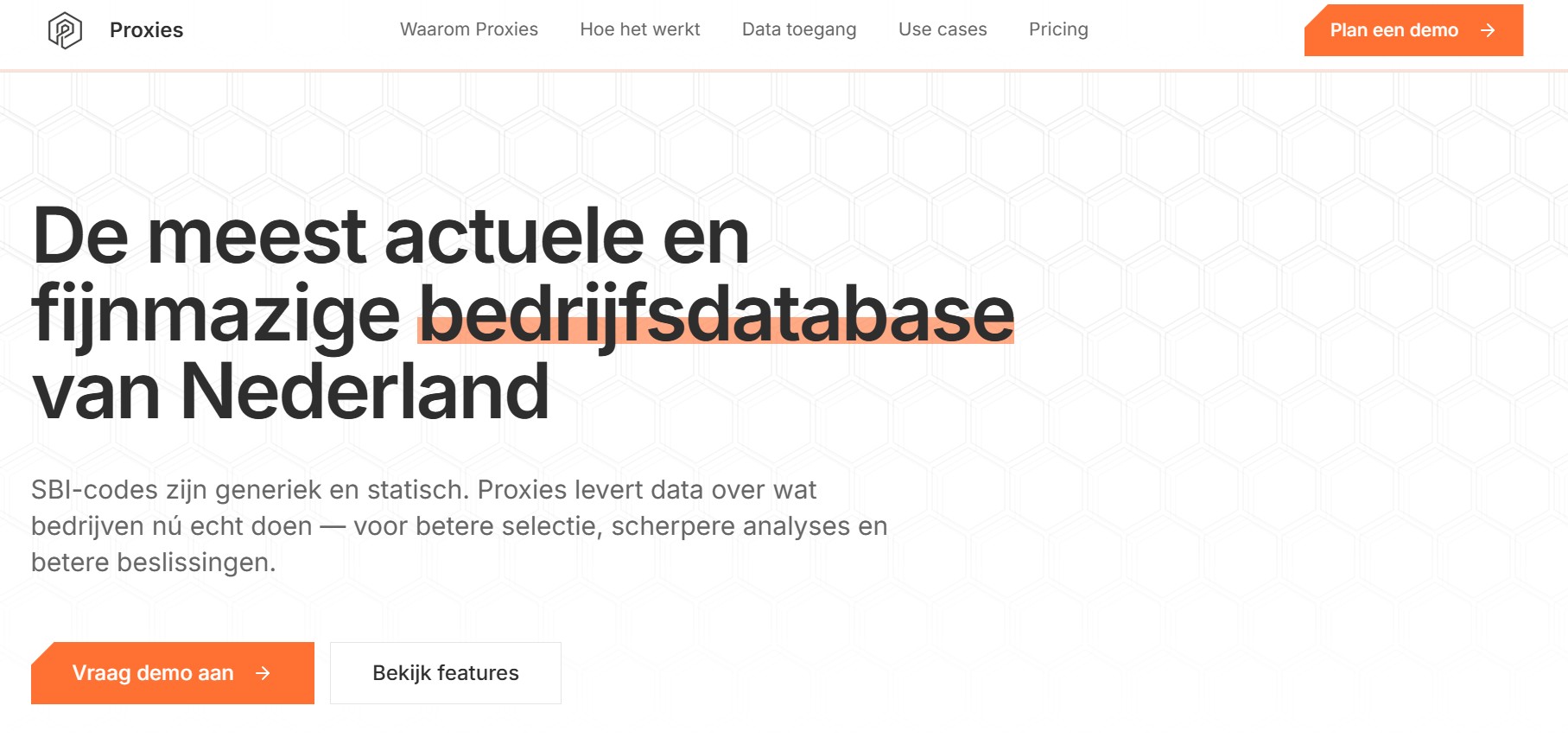
A concrete example of this is Proxies, a company that we recently started. At Proxies, we build highly detailed business databases for Europe. Traditional databases are essentially static. They include snapshots of information: sales figures, number of FTEs, sector classifications and other business characteristics. Updates are often periodic, depending on fixed sources or manual input. The information is valuable, but always a snapshot.
With the use of Agentic AI, that is fundamentally changing. Instead of a database that only stores what is known, we create a system that actively collects and understands information. Our AI Agents act like digital researchers. Just like humans, they focus on finding relevant information about companies on the web and in public data sources. They analyse context, recognize signs of change and continuously monitor developments.
Examples include changes in the number of employees, sales growth or contraction, new branches, strategic announcements or changes in management. Where this was previously only possible with large analyst teams or limited samples, this can now be done in a scalable and continuous way thanks to Agentic AI. The system does not wait for a quarterly update; it actively monitors what happens.
This was simply not possible before. Not because there was no need, but because the technology was lacking to collect contextually and intelligently information at scale. Agentic AI makes it possible to build software that not only manages data, but actively generates knowledge.
And here is the crux of my argument. Generic AI solutions are powerful, but they are broad and comprehensive. They don't know the nuance of a specific market, sector, or use case at the level where specialized software can. The real value comes when you combine AI with deep domain understanding, structured data, and a clear product vision. Then AI will not be a replacement for software, but an infrastructure layer within software.
So SaaS companies are not facing an existential crisis, but a strategic choice. Are you going to stick to a model where functionality is key and AI is seen as a threat? Or are you redefining your product by integrating AI as a core component and taking your solution to the next level?
The opportunities created by plug-ins, agentic systems and new AI tools are enormous. They make it possible to build software that is proactive rather than reactive, intelligent instead of static, and adaptive instead of fixed. This requires redesigning products, rethinking business models and, above all, guts.
That's why I want to challenge companies not to react defensively to the rise of AI, but to think offensively. Don't ask “how do we protect ourselves against AI?” , but “how can our software absorb AI and thereby become better than ever?”
Because AI doesn't lower the level of software. It goes up. Much higher than we thought possible so far.
Learn and learn more about Proxies? Check proxies.ai.nl
.svg)


