.svg)
AI Opinie
Silicon Valley versus China: two AI futures — and the choice that the Netherlands faces today

Job van den Berg
February 1, 2026
4
min read
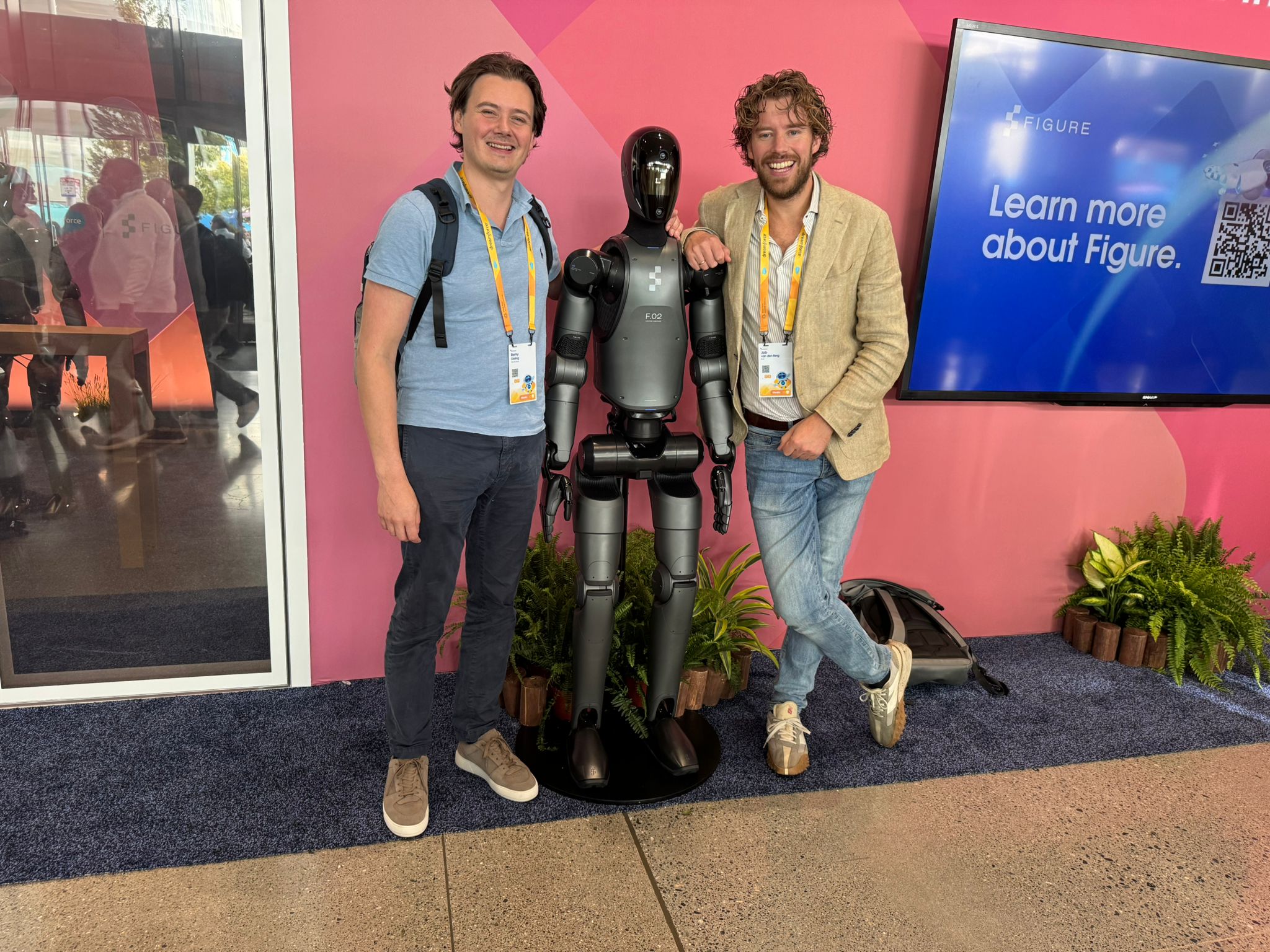
Pictured with a Figure humanoid robot at Dreamforce 2025
After two intensive AI trips — one through the United States, including visits to Silicon Valley, and one through China — we take stock. Two countries, two completely different approaches to artificial intelligence. Where Silicon Valley runs on speed, experimentation and entrepreneurship, China shows what is possible if innovation is centrally managed and rolled out on a large scale.
Both systems work. But they each follow a different logic — and that is also the lesson for the Netherlands.
When you travel through Silicon Valley, you feel energy - an ecosystem that is constantly changing.
Here, AI is no longer a technology, but an infrastructure: something that drives everything, from business strategy to scientific research. But when you put on those same glasses and look at China, you see something completely different — and just as impressive. This is not about innovation from experiment, but about innovation at scale. Where Silicon Valley thrives on openness and speed, China excels in integration and execution. Two extremes, which together dominate global AI developments.
And right in between: the Netherlands, which is still looking for its own route.
Silicon Valley's speed: innovation as a reflex
In Silicon Valley, the pace is astounding. The major AI labs at companies such as OpenAI and Anthropic are releasing new models at a pace that looks more like software releases than research breakthroughs. What is impossible today will be solved tomorrow. That's not what the conversations are about. what AI can do, but to how we make it more sustainable, efficient and reliable. The focus is on optimization: less energy, more performance. Everyone works on the same stack: from chips to models, from data centers to end applications. And what is striking - and is also different from our trip last year - the entire ecosystem is moving in one direction. The collaboration between hardware builders, model trainers, developers and investors is close — not through regulation, but through a shared goal: the acceleration of intelligence. AI isn't something that “you're going to use”, it is the engine of everything.
In China, on the other hand, it is not the speed of innovation that stands out, but the scale of implementation. Where Silicon Valley builds AI, China applies it — everywhere, at the same time and on an unprecedented scale. During the trip to Chinese tech hubs, that was particularly striking: the extent to which AI is already intertwined in society. From smart cities to logistics hubs, from retail to healthcare — it's all about data-driven decision making. Chinese companies are not waiting for the technology to be “finished”. They continue to build as they deploy. Experimentation does not happen in labs, but in the real world. And because government, industry and universities work closely together, a flywheel of policy, funding and implementation is created that is difficult to match. Where Silicon Valley thrives on entrepreneurship, China drives coordination. The result: an unprecedented rate of adoption, but often less room for fundamental reflection or ethical opposition.
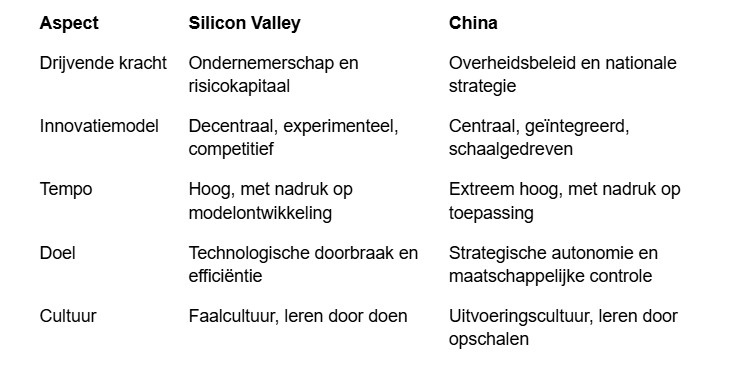
Both models provide impressive results. But they also highlight each other's weaknesses:
The Netherlands is in an uncomfortable middle position. We have talent, infrastructure and knowledge — but lack focus and pace. We have the creativity of Silicon Valley, but not the investment rhythm.
We have China's organizational strength, but not decisiveness. As a result, AI often lingers here in pilot projects, strategy consultations and policy documents. The real scale — the one where AI transforms processes, companies and sectors — is still missing. The key question is therefore not whether The Netherlands can participate, but whether we dare to choose. Opting for a direction, a vision, a national ambition that goes beyond separate initiatives.
Innovation requires freedom, not consent. The Netherlands must create the space to experiment, make mistakes and learn.
Rapid iteration is the engine of progress.
Good ideas die in the pilot phase if there is no policy or infrastructure to scale up.
The Netherlands has strong knowledge institutions and companies — but lacks an integrated system in which government, business and education work together.
AI should not only be a technological project, but also a social compass.
We need to determine Wherefore we want to use AI: not just for efficiency, but for broad progress.
The AI revolution won't wait for us to be ready.
China is building scale, Silicon Valley is building speed — and both are building future leadership.
If the Netherlands wants to remain relevant, we need to combine the unique strength of both worlds:
This requires vision, guts and cooperation. Don't wait until it's “safe” to experiment, but take the plunge right now. Because the future of AI isn't written by the fastest or the biggest — but by those who dare to act most effectively.
.svg)


