

6 tips on how Claude Code accelerates your IT goals with AI-assisted coding
From Anthropic to Google: tech giants are using AI to build their own products. This is how your IT organization can innovate at the speed of Silicon Valley.
-2026-01-04%20at%2018.13.23.png)
While many Dutch IT departments are still debating the reliability of AI-generated code, reality has already overtaken them. Anthropic CEO Dario Amodei recently confirmed that at his company, 90% of all code is now written by AI. Google reports that more than 25% of their internal source code is AI-generated. Microsoft CEO Satya Nadella mentioned 30%. And these are not predictions for the future-this is today's reality.
The benefit for frontrunners is evident: according to recent research, an average of 41% of all code worldwide is now AI-generated, with 256 billion lines in 2024 alone. The average enterprise employee saves 40-60 minutes per day using AI tools. Heavy users save more than 10 hours per week-effectively an extra workday.
But the real story isn't in the percentages. It's in the fundamental shift of what it means to be a developer.
The lessons of Boris Cherny: developer of Claude Code
In early January 2026, Boris Cherny, the developer behind Claude Code at Anthropic, shared his workflow on X (formerly Twitter). His insights offer a rare look into how frontier AI companies actually work with AI-assisted coding. And that methodology is radically different from what most organizations are accustomed to.
Parallel agents: playing chess on multiple boards at once
Cherny typically runs 5 Claude instances in parallel in his terminal, numbered 1 to 5. Additionally, he runs another 5-10 Claude sessions via claude.ai/code, parallel to his local sessions. This is not exaggeration or showmanship-it is pure necessity.
The reason is simple: inference time. While one AI agent is generating code, analyzing, or testing, the developer cannot wait passively. Instead, he instructs the next agent, reviews output from a third, and plans the approach for a fourth. It's like playing simultaneous chess on five to fifteen boards at once.
This requires a fundamentally different skillset. Deep knowledge of a single programming language is no longer the most important factor. Instead, the ability to effectively manage multiple agents and maintain oversight becomes crucial.
The best model, always
Cherny exclusively uses Claude Opus 4.5 with 'thinking' mode for all his work. His reasoning: although the model is larger and slower than Claude Sonnet, it requires less steering and is superior in tool use. As a result, it is almost always faster in the end than a smaller model. The lesson: don't choose the fastest model, but the model that requires the fewest corrections.

CLAUDE.md: the collective memory
The Claude Code team shares one CLAUDE.md file for the entire repository. This file is checked into Git, and the whole team contributes to it several times a week. Every time Claude makes a mistake, it's added to this file so the AI performs correctly next time. This is 'Compounding Engineering' in action: every lesson makes the system smarter.
Plan first, code later
Most sessions start in 'Plan mode'. Cherny iterates with Claude until he is satisfied with the plan. Only then does he switch to 'auto-accept edits mode', after which Claude can usually execute the implementation correctly on the first try. A good plan truly is half the battle.

Slash commands for repetitive workflows
For every workflow that occurs several times a day, Cherny creates slash commands. These are checked into Git and live in .claude/commands/. This not only saves time during prompting but also allows Claude itself to use these workflows.
Tip 5: Code review with @.claude on GitHub
During code reviews, Boris regularly tags @.claude on colleagues' pull requests to directly add adjustments to CLAUDE.md as part of that same PR. The team uses the Claude Code GitHub Action for this (installable via /install-github-action).
This means every code review not only improves the code but also the team's collective AI memory. Every PR becomes an opportunity to make Claude smarter for next time. Boris calls this their version of "Compounding Engineering"-a term by Dan Shipper-where every interaction makes the system exponentially better.
Practical application: Install the Claude Code GitHub Action and make it a team habit to check during every code review: "Did Claude make a mistake here that we can document?" This way, you organically build a knowledge base specific to your codebase and team conventions.

Why this matters for European organizations
In the European IT landscape, there is still significant skepticism about AI-assisted coding. Developers frequently state that 'AI is not good at coding at all.' But frontier AI companies are proving the opposite-not through marketing, but through their own products.
Anthropic states: 90% of our code is written by AI. OpenAI, Google, Microsoft-they are all embracing this technology. Not because it is fun, but because they have limited resources. Limited developers. Limited time. And they must remain competitive against one another.
The question for IT teams is not if they will use these tools, but when. And the answer should be 'now.' Because the gap between 'frontier' organizations and the rest is widening every month.
Tools enabling the revolution
Tools for AI-assisted coding are now widely available and increasingly accessible:
- Claude Code – Anthropic's agentic coding tool that works directly in your terminal. Understands your entire codebase, executes commands, debugs issues, and creates pull requests. Now generally available with VS Code and JetBrains integrations.
- Cursor – An AI-powered fork of VS Code that combines deep codebase indexing with multi-model flexibility. Supports models from OpenAI, Anthropic, Google, and xAI. Used by teams at Stripe and Ramp.
- KiloCode – Open-source, model-agnostic AI coding assistant with over 500,000 active users. Supports 400+ models and offers modes for Architect, Coder, Debugger, and Orchestrator. Transparent in pricing and data usage.
- GitHub Copilot – Microsoft's AI assistant, now used by millions of developers worldwide. Integrated into VS Code, JetBrains, and other popular IDEs.
- Google Antigravity accessible vibe coding IDE to quickly create proof-of-concepts for developers on the Google GCP stack.
The common denominator: these tools are no longer 'autocomplete on steroids.' They are agentic-they can plan, execute, test, and iterate with minimal human intervention.
The new role of the developer
Does this mean developers are becoming obsolete? On the contrary. The role is changing fundamentally, but is not becoming less important or relevant. In fact, to deliver 80% more output and stay competitive, skilled developers are more essential than ever.
The new developer is:
- An orchestrator – Managing multiple agents simultaneously, maintaining oversight, and knowing which agent to deploy for which task.
- An architect – Deep understanding of IT architecture becomes more critical. AI can write code, but strategic architectural decisions require human insight.
- A quality controller – Reviewing, validating, and refining AI output. Knowing when code is 'good enough' and when it is not.
- An MCP expert – Model Context Protocol (MCP) enables connections with external applications. This opens doors to specialized sub-agents for specific tasks.
- Security specialist - Agentic AI is not a magic box; deep knowledge of the possibilities and limitations of digital security within models, guardrails, API security, and related matters is indispensable for applying applications enterprise-wide.
Our experience: from 300+ organizations to Silicon Valley
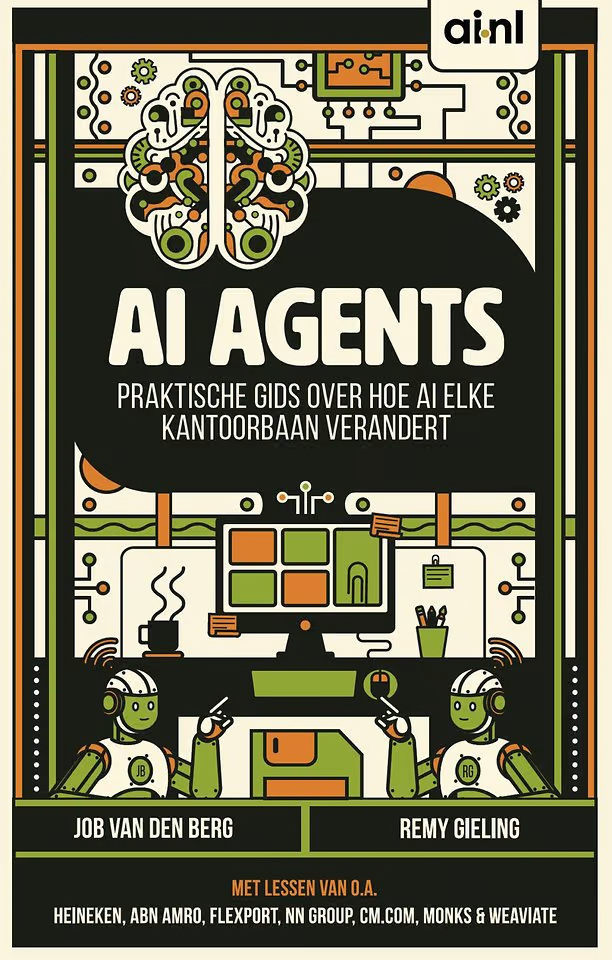
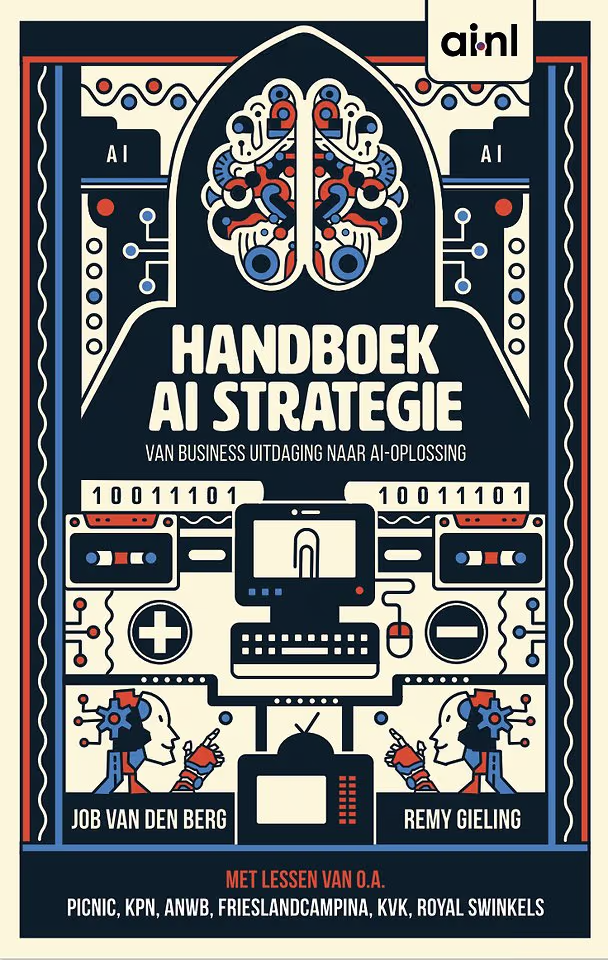
From ai.nl, we advise more than 300 leading organizations annually on AI adoption. From KPN and ASML to KLM and Coca-Cola-we see the challenges and opportunities of AI transformation up close. We provide AI trend update keynotes and facilitate AI skills and AI tools workshops. We have bundled our knowledge in the Handboek AI Strategie (2024), AI Agents (2025), and our AI Agents e-learning.
Via The Automation Group, we provide 'forward deployed engineers' for organizations such as ANWB, InShared, Malmberg, BDO Netherlands, and Wolters Kluwer. Technically proficient professionals who understand everything about Agentic AI Frameworks. Our motto: low-code where possible, high-code where necessary via microservices within the IT architecture. We always work on client systems and provide workshops on both low-code automation and high-code multi-agent orchestration.
With a new initiative, we collect millions of public data points to make predictions about corporate behavior for sales, marketing, recruitment, and KYC. A database for Companies 2.0.
And we don't just gather our knowledge in the Netherlands. Several times a year, we travel to China and Silicon Valley to speak with tech leaders at frontier companies-Nvidia, OpenAI, Tencent, Salesforce, and others-about the impact of AI on work and business. This direct access to the source ensures we identify trends earlier and can better translate them to local contexts.
Workshops: from vibecoding to multi-agent orchestration
The Automation Group provides practical workshops for teams looking to start or accelerate with AI-assisted development:
- Vibecoding Workshop – For teams wanting to start with AI-assisted coding. Hands-on experience with tools like Cursor and Claude Code. Learn the basics of effective prompting and managing AI agents.
- Low-Code Automation – Maximize productivity with minimal technical overhead. Ideal for business teams who want to do more with less code.
- High-Code Agentic AI Frameworks – For technical teams building enterprise-grade AI solutions. Deep-dive into architecture, microservices, and integration. Includes model evaluations.
- Agentic AI Assisted Coding – The full method as applied by Boris Cherny and frontier AI companies. From parallel agents to CLAUDE.md, from plan mode to slash commands.
Conclusion: the time for waiting is over
Frontier AI companies are demonstrating what is possible. 90% of code written by AI. Developers playing on fifteen chessboards at once. Teams capturing their collective knowledge in CLAUDE.md files that get smarter every day. This is not the future. This is now. And organizations that want to stay ahead can no longer remain on the sidelines. The role of the IT professional is not changing-it is becoming more complex, challenging, and important. But only for those who adapt.
Ready for the next step? Contact us for a consultation on how AI-assisted coding can transform your IT organization.
Want to get started with AI yourself? View our AI workshops for teams or AI keynote.
// About the author
Remy Gieling
Mede-oprichter, AI-expert & bestseller-auteur
Tech-expert (1988) gespecialiseerd in kunstmatige intelligentie en mede-oprichter van ai.nl, The Automation Group, Proxies en eBrain.ai. Oud-hoofdredacteur van diverse zakenmerken en daardoor een geoefend verteller op het podium en in de media. Verzorgt jaarlijks 150+ AI-keynotes in binnen- en buitenland en is gastdocent aan Nyenrode. Co-auteur van zeven boeken, waaronder 'Handboek AI Strategie' en 'AI Agents', en bekend als presentator op radio en RTL Z. Reist langs de labs van OpenAI, Nvidia en Tencent en vertaalt de nieuwste doorbraken naar inzichten die leiders direct kunnen toepassen.
LinkedIn