

AI Agents Solve What Traditional Data Systems Cannot
AI Agents are not only designed to bridge data gaps, but specifically to unlock new data opportunities. Not by simply collecting more data, but by understanding data in context and translating it into predictive insights.

Within many organizations, data is still seen as a prerequisite for AI: the more complete, current, and consistent the data, the better the result. In practice, however, data is rarely perfect. It is fragmented, outdated, incomplete, or difficult to interpret. Traditional systems primarily experience this as a problem. AI Agents approach this reality differently. They are not only designed to bridge data gaps, but specifically to unlock new data opportunities. Not by simply collecting more data, but by understanding data in context and translating it into predictive insights.
From deterministic systems to contextual reasoning
Classical software systems are deterministic in nature: the same input always leads to the same output. This principle has served as the foundation for automation, databases, and reporting systems for decades.
AI Agents break this paradigm. They are designed to:
- interpret information in coherence
- accept uncertainty
- apply nuance
- weigh multiple perspectives
Just like humans, AI Agents do not just look at what is stated, but also why, how, and in what context information is presented. This means that two seemingly similar data points, depending on their context, can lead to different conclusions.
This non-deterministic approach makes AI Agents particularly suitable for complex and unstructured information environments.
Handling a diversity of information sources and formats
An important consequence of contextual reasoning is that AI Agents can work effectively with a multitude of information sources, including:
- textual content
- web pages
- public documents
- semi-structured data
- implicit signals in language and presentation
Specifically, company websites constitute a valuable source of up-to-date information. They provide insight into positioning, ambitions, propositions, culture, and sometimes even internal changes. Unlike formal registrations, websites are often updated as soon as an organization changes.
AI Agents can interpret these signals, compare them, and link them to other data sources to form a richer and more current picture.
The limitations of static data sources
Public registers, such as chambers of commerce, land registries, and other official data sources, play a crucial role in data-driven analyses. They offer structured, verified, and legally anchored information.
At the same time, these sources have clear limitations:
- updates occur periodically
- changes are often delayed by administrative processes
- many relevant developments are not registered
Organizations, however, change continuously. Teams grow or shrink, roles shift, strategic focus changes, and propositions evolve. This dynamism is rarely reflected immediately in static registers.
Therefore, these sources function best as validation and reference points, not as a complete representation of reality. By testing dynamic signals against formal data, a more reliable and consistent analytical framework is created.
Proxies: derived signals as the key to hidden insights
A second fundamental principle behind modern AI systems is the use of derived signals, also called proxies.
A proxy is a measurable data point that strongly correlates with a property that is not directly visible or measurable itself. Think of behavior, intent, maturity, or organizational complexity.
Examples of proxies can include:
- language usage on a website as an indicator of market focus
- structure of content as a signal for organizational maturity
- consistency between different sources as a measure of stability
By combining multiple proxies, AI Agents can derive characteristics that are nowhere explicitly recorded but certainly exist. This is not about speculation, but about statistically and contextually grounded correlations.
From descriptive data to predictive models
Where traditional data systems are primarily descriptive-what happened?-the role of AI Agents is shifting toward prediction and interpretation.
By recognizing patterns in historical and current data, AI Agents can:
- estimate probabilities
- predict future developments
- uncover latent characteristics
This predictive capacity makes it possible to look ahead instead of analyzing after the fact. Not by claiming certainty, but by making better-founded assumptions.
Toward living, adaptive insights
The combination of contextual analysis, validation via formal sources, and proxy-based predictions leads to a new type of insight: living insights.
These are insights that:
- move along with changes
- explicitly incorporate uncertainty
- are continuously adjusted based on new information
AI Agents do not function as a replacement for human judgment in this regard, but as an enhancement of it. They help reduce complexity, make hidden patterns visible, and provide better support for decision-making.
The value of AI Agents lies not in collecting more data, but in understanding meaning, context, and change. By combining static and dynamic sources and utilizing proxies, a deeper, more current, and predictive picture of organizations and their environment emerges.
This marks a shift from static data models to adaptive intelligence: a necessary step in a world that is changing faster than ever.
And for exactly that reason, we recently launched our new company and initiative, Proxies. Proxies provides the most up-to-date and granular business database in the Netherlands. Take a look at: proxies.ai.nl

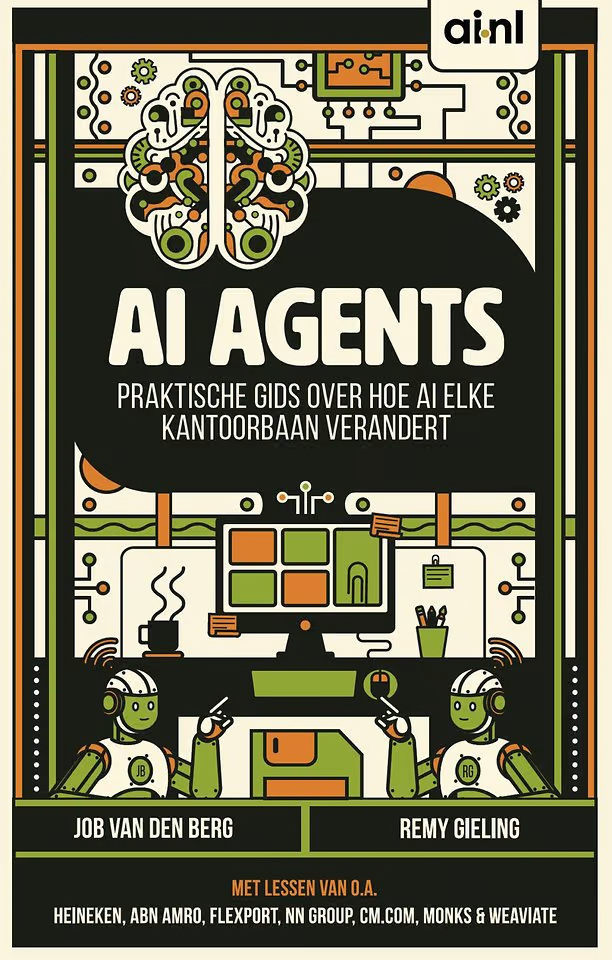
Getting started with AI yourself? Check out our e-learning AI Agents or AI workshops for teams.
// About the author
Job van den Berg
Mede-oprichter, AI Keynote Spreker & Techondernemer
Tech-ondernemer (1989) met een achtergrond als socioloog (Research Master (MSc) in statistiek en sociologie) en een van de meest gevraagde keynote sprekers over AI en data in Nederland. Als mede-oprichter van Ai.nl, The Automation Group en Proxies leidt hij engineers die agentic AI van prototype naar productie brengen binnen enterprises. Op het podium vertaalt Job die hands-on praktijk naar concrete strategieën. Eerder was Job Chief Data bij o.a. DPG Media en Kantar. Hij is co-auteur van 5 boeken over AI waaronder 'AI Agents' en 'Handboek AI Strategie' en een veelgevraagd expert in de landelijke media.

LinkedIn