

We value your privacy

    We use cookies to analyse traffic, improve our website and show relevant content. You choose what we may use. Read our privacy policy.

    Live AI news
    Back to articles// AI Trends

    The AI efficiency illusion: why you aren't actually working as fast as you think

    Job van den Berg Published 15 juni 2026 5 min read
    Businessperson at desk staring at hourglass and AI chat bubble — symbol of the efficiency illusion

    1. Self-estimate miscalibration

    People truly have no clue about their own behavior. When you ask professionals how often they use an AI tool in their workflow, they systematically estimate it to be much lower than the hard logs actually reveal. We like to think we're in the driver's seat, making the majority of decisions ourselves. In reality, we're summoning the tool for every little triviality without even realizing it.

    2. The efficiency-gain illusion

    This is the real threat to your productivity. We have a chronic tendency to overestimate how much time and cognitive effort AI is actually saving us. A task feels lighter simply because we 'outsource' the work to an interface. The fact that the preparation, the prompt, the wait for the output, and the final review ultimately eat up just as much or more time, is effortlessly filtered out by our brains. It feels like we're moving at warp speed. But feelings are a terrible KPI.

    The dangerous feedback loop

    What makes this research essential for teams is the observed carryover effect. If you've already used AI a few times during a work session, the odds increase exponentially that you'll immediately open that tool again for the next, even simpler task. Prior use directly fuels new use, reinforcing that blind efficiency illusion.

    The ultimate risk here is an overreliance feedback loop. You use AI, your brain registers a false, inflated sense of time saved, you subsequently use it for an even more banal task, and slowly but surely, your own cognitive capacity and critical eye begin to erode. Before you know it, an entire team's productivity becomes dependent on a language model, without any actual improvement in output quality or speed.

    Three no-nonsense guidelines for your team

    If we simply 'unleash' AI adoption in a department without any guardrails, we aren't innovating; at best, we're creating digital bureaucracy at a micro level. How do you avoid the illusion in practice? When rolling out implementations, I always stick to the following rules of thumb.

    Measure actually, not by feel

    Stop running employee surveys that ask whether people 'feel more productive' since getting Copilot or ChatGPT. That feeling is irrelevant and heavily skewed. Make it objective. Design a simple A/B test in your operation for your most common processes. Measure the actual clock time spent per task, including any editing time on AI-generated content. Hard seconds beat assumptions.

    Reserve AI for the heavy lifting

    Models excel at pattern recognition, synthesizing a hundred pages of meeting documents, or setting up a complex project plan. That's where your real return on investment (ROI) lies. Make it clear to your team that we deploy these tools for cognitively heavy tasks. Teach them to analyze the weight of a task before slamming the shortcut button.

    Build in friction for simple tasks

    We've sometimes set up our workplaces so the AI assistant jumps to the foreground everywhere. Bring some friction back. Adopt a simple 'thirty-second rule' with your team. Need to do a basic calculation or answer a factual question from a colleague that you could handle yourself in half a minute? Stay away from the prompt bar. It keeps the mind sharp and eliminates the waiting time on unnecessary machine output.

    The bottom line

    Every disruptive technology seduces us with the dream of limitless time savings. But if we put a massive neural network to work for every basic typo, calculation, or short email, we aren't being efficient we're deceiving ourselves out of intellectual laziness. Use AI where it exponentially amplifies your cognitive power, not as an excuse to stop thinking for yourself during simple office chores. Reality rewards actual results, not illusions.

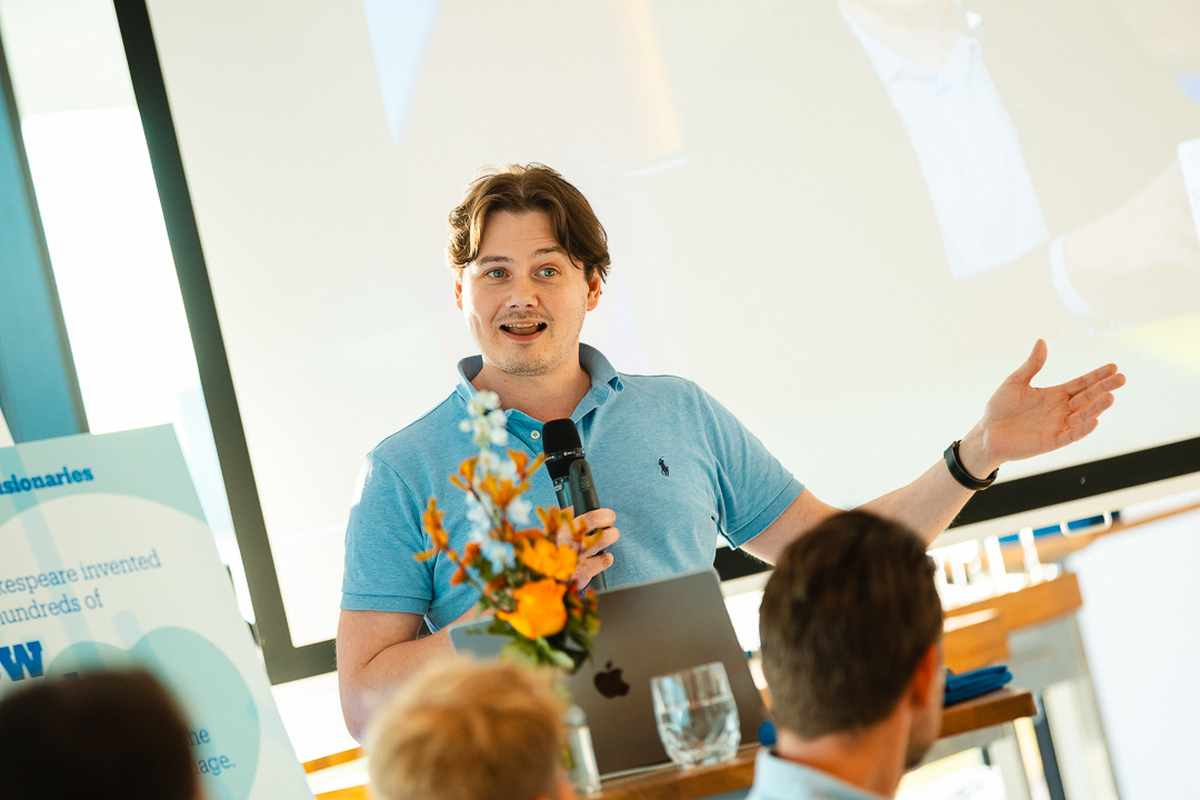
    Job van den Berg — Mede-oprichter, AI Keynote Spreker & Techondernemer bij ai.nl

    // About the author

    Job van den Berg

    Mede-oprichter, AI Keynote Spreker & Techondernemer

    Tech-ondernemer (1989) met een achtergrond als socioloog (Research Master (MSc) in statistiek en sociologie) en een van de meest gevraagde keynote sprekers over AI en data in Nederland. Als mede-oprichter van Ai.nl, The Automation Group en Proxies leidt hij engineers die agentic AI van prototype naar productie brengen binnen enterprises. Op het podium vertaalt Job die hands-on praktijk naar concrete strategieën. Eerder was Job Chief Data bij o.a. DPG Media en Kantar. Hij is co-auteur van 5 boeken over AI waaronder 'AI Agents' en 'Handboek AI Strategie' en een veelgevraagd expert in de landelijke media.
    LinkedIn
    // GET STARTED// How we can help

    Beyond reading — let AI work for you.

    // CONTINUE READINGAll articles

    More from AI Trends.

    Newsletter

    Always up to date on AI.

    Once a month: cases, frameworks and concrete examples of what works in practice. No noise.

    No spam. Unsubscribe any time.