

We value your privacy

    We use cookies to analyse traffic, improve our website and show relevant content. You choose what we may use. Read our privacy policy.

    Live AI news
    Back to articles// AI Trends

    The Matthew Effect in AI: Why the Workplace Gap is Widening (and How Managers Can Stop It)

    AI promised equal opportunities, but reality shows the Matthew Effect: the gap between frontrunners and stragglers is widening. How can managers prevent a divided workforce?

    Job van den Berg Published 1 juni 2026 Updated 15 juni 2026 8 min read
    Mattheüseffect in AI-adoptie op de werkvloer

    The Illusion of the Great Equalizer

    When generative AI like ChatGPT first burst onto the scene, the promise was as utopian as it was straightforward: this is going to be the great equalizer. An intern would suddenly be capable of drafting copy like a senior writer. A novice programmer could produce clean, bug-free code at the speed of a hardened veteran. The technology was supposed to inject the lower tiers of the labor market with a massive productivity boost, thereby shrinking the skills gap between top performers and the middle of the pack. It sounded phenomenal on paper. However, reality on the work floor is currently painting a starkly different, far grimmer picture.

    We are currently witnessing what sociologists call the 'Matthew Effect' in AI adoption. This principle, derived from the biblical parable in the Gospel of Matthew, essentially states: 'For to everyone who has, more will be given, and he will have abundance; but from him who does not have, even what he has will be taken away.' In colloquial terms: the rich get richer, and the poor get poorer. In the context of artificial intelligence, this translates to an uncomfortable truth: employees who are already high-performing and digitally fluent are embracing the technology and supercharging their output. Those who lag behind are increasingly, and almost desperately, avoiding it. This dynamic, sharply analyzed recently by Job van den Berg in the science segment of AI at Work Live (BusinessWise / DPG Media / New Business Radio), is now painfully corroborated by hard data from two major scientific studies.

    The Danish Mirror: Existing Inequality on Steroids

    Let’s start by looking at the sociodemographic impact. In an extensive Danish study titled 'The unequal adoption of ChatGPT exacerbates existing inequalities among workers', published by Anders Humlum and Emilie Vestergaard in the Proceedings of the National Academy of Sciences (PNAS, early 2025), the skewed nature of adoption becomes abundantly clear. The researchers dove deep into population data to uncover who is actually using these tools, and more significantly, who is ignoring them entirely.

    The findings leave little room for optimistic interpretation. It is predominantly men, the highly educated, and younger employees (though the specific demographic of 'juniors' is facing a unique crisis, which we will address later) who actively integrate ChatGPT and similar tools into their daily workflows. What makes this study so critical is the realization that this unequal adoption isn't leveling the playing field; it is putting society's existing inequalities on steroids. A highly educated professional with a strong network and extensive skills uses AI as a flywheel to double an already high output. Conversely, the less formally educated worker, who historically already occupies a more vulnerable position, shuns the tool due to insecurity, a lack of targeted training, or simple disinterest.

    Humlum and Vestergaard successfully demonstrate that the technology itself doesn't inherently create inequality-the human reaction to it does. AI is viewed by frontrunners as a cognitive exoskeleton. To those who avoid it, however, it feels like an elusive threat. Rather than experimenting, they retreat into familiar, inefficient routines. This is the Matthew Effect in its purest form.

    The American Canary in the Coal Mine: Juniors Left Behind

    The situation becomes even more alarming when we zoom in on the cold, hard employment data. A paper from the prestigious Stanford Digital Economy Lab (November 2025), authored by heavyweights Erik Brynjolfsson, Bharat Chandar, and Ruyu Chen, drops a massive bombshell. Under the title 'Canaries in the Coal Mine? Six Facts about the Recent Employment Effects of Artificial Intelligence', the researchers analyzed the wage and employment data of millions of American workers via payroll processor ADP.

    Their discovery highlights a statistic that should keep every HR director and CEO awake at night: young workers aged 22-25, working in professions highly exposed to AI, are currently experiencing a relative employment decline of a staggering 16 percent compared to non-exposed sectors. Sixteen percent. That is not a minor statistical blip; that is a structural shift in how organizations are hiring (or rather, no longer hiring) fresh talent.

    What explains these numbers? The researchers suggest that companies simply need fewer junior or entry-level positions because mid-level and senior employees-empowered by AI-can now handle the bulk of standard, foundational work themselves with the push of a button. Where companies previously required an army of recent graduates to crunch data, draft initial reports, or write boilerplate code, the seasoned worker now executes this efficiently via targeted prompts. Young people, often assumed to be 'digital natives' who would naturally reap the benefits of this tech, prove to be the absolute canaries in the coal mine. They are benched because the entry-level tasks they were traditionally hired for have been automated before they even get the chance to prove their worth to the organization.

    The Bitter Paradox of AI Adoption

    When we combine the Danish PNAS study and the Stanford ADP research, we arrive at the bitter paradox of this decade-a point insightfully underscored by Job van den Berg. It is the ultimate irony of our current AI revolution: exactly those professions and employees who stand to gain the absolute most profoundly from artificial intelligence, are the ones embracing the technology the least.

    Why is this happening? Why does a drowning person refuse a life jacket? It boils down to a fear of failure and a lack of psychological safety in the workplace. Employees who feel insecure about their job standing are terrified of making mistakes with technologies they don't fully conceptualize. 'If I mess up using ChatGPT, it's my fault. If I do it the way I've always done it, no one can point fingers,' becomes the unspoken internal monologue. The employee who already excels, internally secure, possesses the confidence to play, to fail at a prompt, to shrug it off and refine it, and ultimately rake in the massive gains in time and quality.

    Practical Guidelines for Managers: Drop the Stick, Offer the Carrot

    This dynamic presents a gigantic, urgent challenge for leadership. If you allow the Matthew Effect to run its course unchecked, you will find yourself leading a deeply polarized organization in two years' time. On one side, a small elite of ultra-productive, satisfied 'AI centaurs' (half human, half machine); on the other, a growing underclass of frustrated, inefficient workers who feel entirely obsolete-or, as seen with the 22-25-year-olds, who aren't even getting hired anymore. This is not just toxic for morale; it is fatal for continuity and profitability.

    The classic boardroom reflex is often to reach for the stick: to issue draconian mandates. "Everyone must achieve two AI-related targets per quarter from now on," or even worse, "We are cutting project hours by 10 percent this year because you need to let AI do the work." This is the exact strategy to drive the insecure employee further into the trenches. Coercion leads to malicious compliance-people will copy-paste the bare minimum to appease management, but they will not fundamentally alter their core workflows.

    The advice, heavily informed by discussions on AI at Work Live, is clear: do not use the stick; use the carrot. Shift the focus from productivity mandates to intellectual curiosity. Let people embrace a sense of wonder. Here are four concrete, in-depth strategies to immediately begin closing the divide in your workforce:

    1. Cultivate Wonder Without Judgment

    Organize weekly "f**k-up" Friday afternoons dedicated exclusively to AI. The goal shouldn’t be to show off brilliant prompts, but to share how hilariously wrong the bot got a task and how the team solved it. Turn AI adoption into an expedition, not a KPI (Key Performance Indicator). Give employees one hour of paid time a week to experiment aimlessly. When the pressure for ROI is removed, genuine understanding of how a Large Language Model 'thinks' can take root. The carrot here is the psychological reward of mastering something new.

    2. Create Fearless 'Buddy Systems'

    Do not pair your resident AI evangelist with your biggest technophobe in a master-apprentice dynamic; that simply breeds shame. Group peers together (for example, two employees from the HR support desk or financial administration) and give them a single shared goal: "See if you two can figure out how to make formatting those dreadful weekly reports easier using Copilot or ChatGPT." Collaborative learning drastically lowers the barrier to entry and builds internal micro-communities of adoption.

    3. Focus on the 'Job to be Done', Not the Tech

    Stop hosting seminars on "How Neural Networks Work" or boring people with deep prompt engineering theories. The average sales rep does not care. Speak to their pain. Say: "Who hates sorting through the monthly client spreadsheets? Let's sit together and figure out if we can turn that five-hour chore into a five-minute task." When you solve immediate, tangible pain points in their daily routine, adoption happens organically, dragging even the most hesitant employees aboard.

    4. Revalue Juniors and Entry-Level Talent

    Take Brynjolfsson's alarming -16% statistic seriously. Do not lock the door on the next generation. If the administrative bulk work they were previously hired for is now done by AI, redefine the entry-level role entirely. Train juniors from day one to be AI operators, curators, and quality control specialists. They might lack the deep domain knowledge of seniors, but by training them alongside the technology, they can manage the AI engine while senior experts elevate their focus to complex strategy and human relations.

    Time for Leadership with a Human Touch

    Technology is a cold amplifier of what already exists. If your corporate culture is rife with friction and inequality, the introduction of generative AI will widen that gap unforgivably. Those who thrive will ascend to unprecedented levels of output. The stragglers will simply wither, rendered obsolete by their refusal to surrender to a tool they do not trust.

    We must transition from abstract technological theory to warm, human-centric management. The Matthew Effect in AI is not invincible, but defeating it requires organizations to acknowledge that the rollout of this technology is the greatest change-management challenge of the last fifty years. You do not solve a challenge of that magnitude with cold coercion or a generic software license. You solve it with empathy, the psychological safety to make mistakes, and by nurturing a genuine human wonder regarding a machine that will inevitably change us all.

    "Exactly those professions and employees who stand to gain the absolute most profoundly from artificial intelligence, are the ones embracing the technology the least."

    Sources

    Job van den Berg — Mede-oprichter, AI Keynote Spreker & Techondernemer bij ai.nl

    // About the author

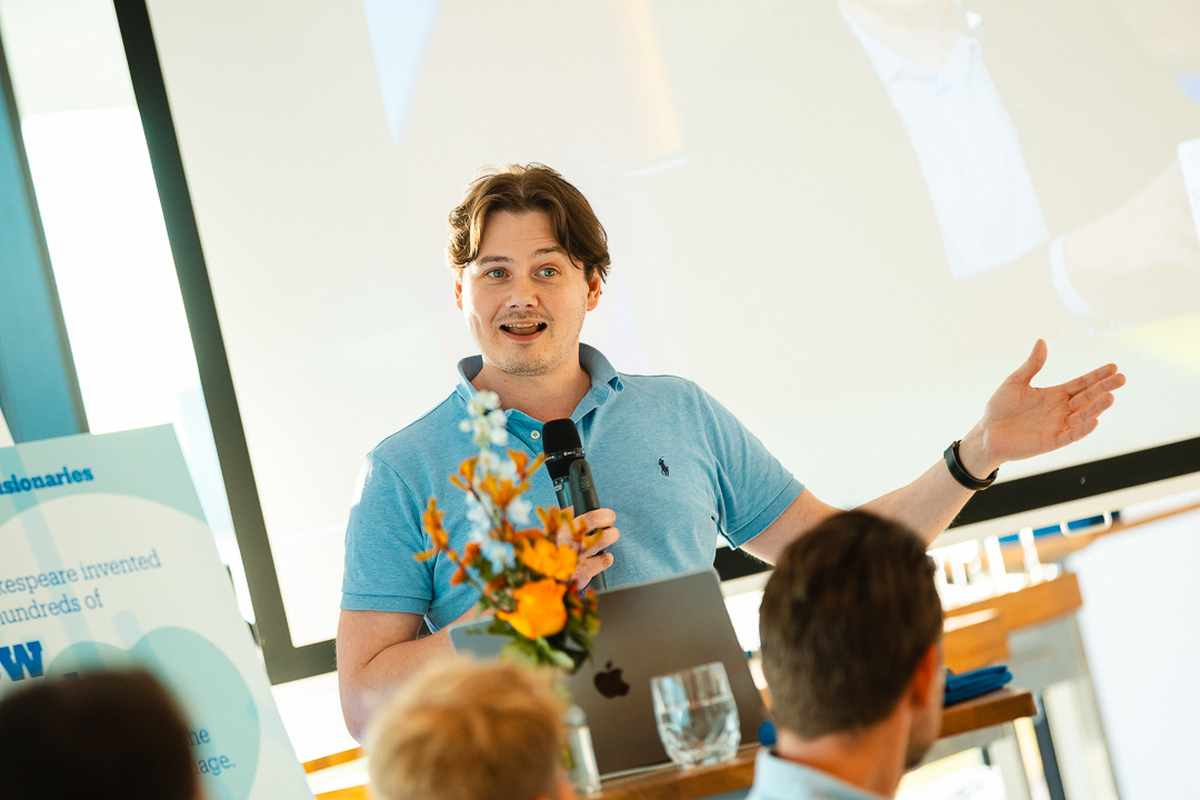
    Job van den Berg

    Mede-oprichter, AI Keynote Spreker & Techondernemer

    Tech-ondernemer (1989) met een achtergrond als socioloog (Research Master (MSc) in statistiek en sociologie) en een van de meest gevraagde keynote sprekers over AI en data in Nederland. Als mede-oprichter van Ai.nl, The Automation Group en Proxies leidt hij engineers die agentic AI van prototype naar productie brengen binnen enterprises. Op het podium vertaalt Job die hands-on praktijk naar concrete strategieën. Eerder was Job Chief Data bij o.a. DPG Media en Kantar. Hij is co-auteur van 5 boeken over AI waaronder 'AI Agents' en 'Handboek AI Strategie' en een veelgevraagd expert in de landelijke media.
    LinkedIn
    // GET STARTED// How we can help

    Beyond reading — let AI work for you.

    // CONTINUE READINGAll articles

    More from AI Trends.

    Newsletter

    Always up to date on AI.

    Once a month: cases, frameworks and concrete examples of what works in practice. No noise.

    No spam. Unsubscribe any time.