

OpenClaw: The AI Agent Revolution SMEs Cannot Afford to Miss
OpenClaw makes AI agents affordable and accessible for small and medium-sized enterprises for the first time.
.jpeg)
A widening gap is emerging in the AI economy. On one side, you have multinationals accelerating at full speed: McKinsey reportedly has 25,000 AI agents active, while Prosus runs 40,000 in its daily operations. On the other side stands the SME sector with the same processes, the same people, and a ChatGPT subscription as their only weapon.
Don't get me wrong: tools like ChatGPT, Claude, Copilot, and Gemini are valuable. They make you 20 percent more efficient, creative, and productive. You write better documents, sharper proposals, and smoother emails. But a tool is ultimately an extension of a human. It makes you better at what you already do it doesn't reinvent how you do it.
That is precisely where AI agents make the difference. And that is why OpenClaw is a game-changer for SMEs.
What is OpenClaw?
OpenClaw is the fastest-growing open-source AI project ever. Built by Austrian developer Peter Steinberger, it began in late 2025 as a personal experiment. Today, the project has over 200,000 GitHub stars and a global community that grows daily.
The concept is refreshingly simple: OpenClaw is a personal AI assistant that runs on your own hardware a Mac Mini, a Windows PC, a Linux server and which you control via the chat apps you already use. WhatsApp, Telegram, Slack, Signal, iMessage, Teams: it doesn't matter. You send a message, and your agent goes to work.
But OpenClaw is not a chatbot. It is an autonomous system that performs tasks, makes decisions, manages files, sends emails, and directs workflows without you having to press a button at every step. Or as Steinberger himself describes it: "an AI that actually does things."
Why this is a breakthrough for SMEs
SME companies rarely have the budgets for six-figure enterprise AI platforms, and the technical know-how to build and integrate such systems is also often lacking. OpenClaw breaks through that barrier on three fundamental points:
You run everything on your own hardware. No expensive cloud subscriptions, no vendor lock-in. Your data remains yours. You install it on a dedicated machine and you own the entire system including all knowledge and conversation history.
You communicate via tools you already know. No new dashboard to learn, no complicated interface. You simply text your agent a task via WhatsApp or Telegram, just as you would message a colleague.
You scale at your own pace. OpenClaw works with a modular skill system. You start small for example, by automating meeting summaries and expand step by step to more complex workflows without having to set up the entire system again.
How we use OpenClaw
At The Automation Group, we have been working intensively with OpenClaw in our own operations for weeks. Our system runs on a local Mac Mini, is accessible 24/7, and we communicate with it via Telegram.
What we do with it:
- Market research after a briefing, our agent automatically retrieves relevant data, sources, and trends.
- Content publishing from research to first drafts, the agent helps speed up the entire content process.
- HR & hiring pipelines screening, communication, and scheduling are largely automated.
- Project proposals after a planning meeting with a client, the agent automatically writes a project proposal based on our templates, fueled by meeting notes from Granola.
That last point is a great example of how powerful the integrations are. OpenClaw supports MCP connections the standard for connecting AI agents to external applications. In our case, that includes Granola (meeting notes), Perplexity (research), NotebookLM (knowledge base), Gamma (presentations), and Lovable (rapid prototyping). These combinations make the system exponentially more powerful than the sum of its parts.
Multi-agent: one team, multiple specialists
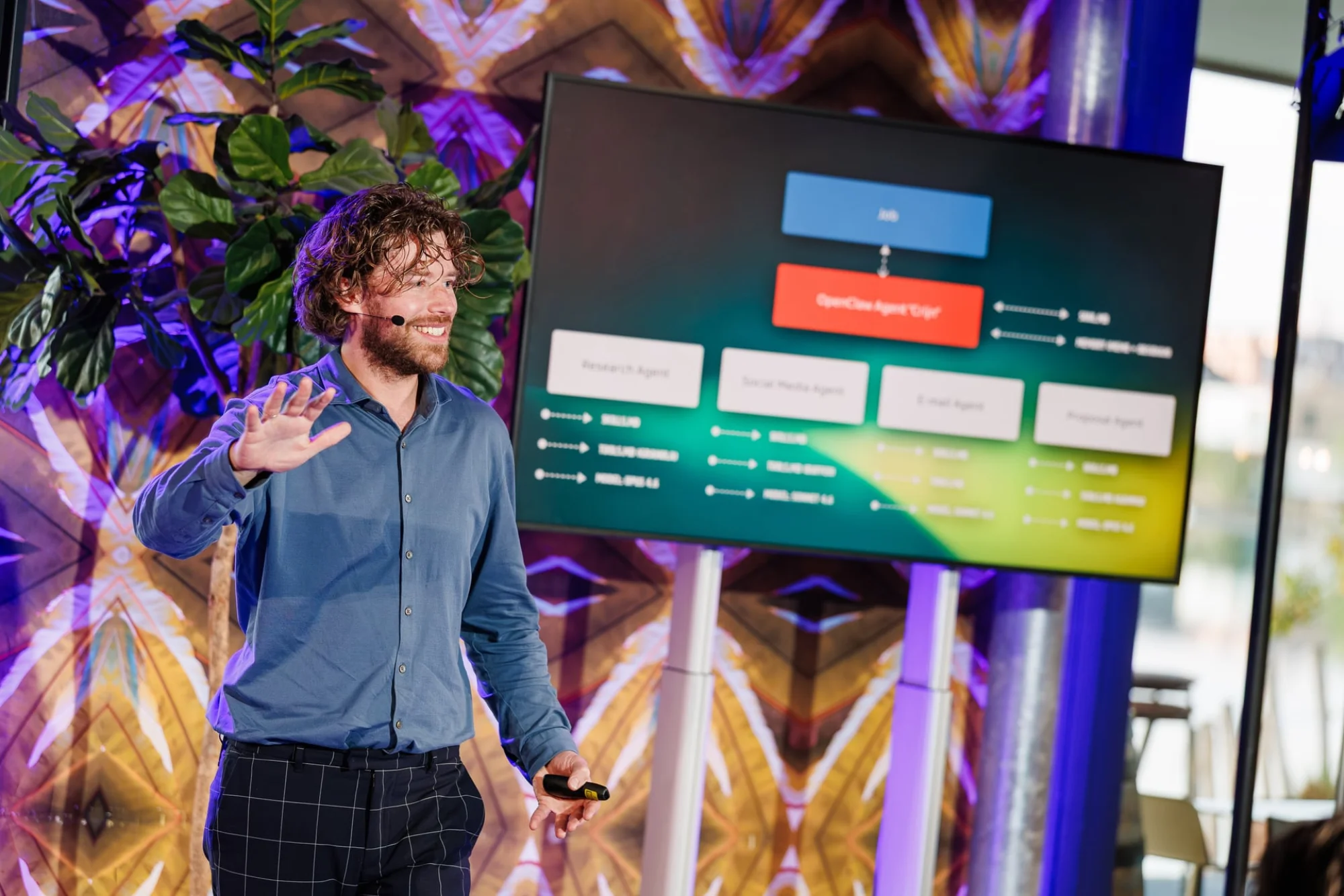
The real power lies in the multi-agent architecture. You have a manager agent that maintains the overview, and beneath it sub-agents that each have their own specialization, knowledge, and tools. One agent is an expert in customer communication, another in financial analysis, and yet another in content creation.
Crucially: you only give each agent access to the knowledge it needs no more. That is your knowledge architecture, the foundation upon which your AI operation runs. Which agent knows what? Which agent is allowed to do what? Setting up that structure is perhaps the most important part of a successful implementation.
The right model choice makes the difference
OpenClaw is model-agnostic: you choose which AI models you deploy. That sounds like a detail, but it is strategically essential. Not every task requires the most powerful (and expensive) model. For simple tasks think of classifying incoming messages or generating standard responses a smaller, cheaper model suffices. Heavy tasks complex analyses, strategic proposals are reserved for frontier models like Claude or GPT-4.
If you don't do this, you will drain your budget on inference costs. And that bill can add up fast if your agents run 24/7. Smart model management is therefore not a nice-to-have; it is a prerequisite.
NVIDIA throws its weight behind it
That OpenClaw is no longer a hobby project was proven by Jensen Huang last week at GTC 2026 in San Jose. The NVIDIA CEO called OpenClaw "the operating system for personal AI" and compared its importance to the arrival of Linux and HTML in the 1990s.
NVIDIA launched NemoClaw: an enterprise version of OpenClaw with built-in security and privacy controls via their new OpenShell runtime. One command, and you have a secure agent platform running with NVIDIA's Nemotron models and sandbox protection.
For large organizations, NemoClaw is the logical next step. But for SMEs, the regular OpenClaw is already more than suitable provided you install and configure it correctly.
Where we help
And that brings me to what we do. Setting up OpenClaw is where the most value lies, and also where it often goes wrong for SME companies. It involves:
- Installing the correct dependencies
- Choosing the right models for the right tasks
- Creating the correct API connections
- Configuring MCP integrations with your existing tools
- Setting up the knowledge architecture: which agent has access to which information
- Defining skills and workflows that fit your business processes
We set that up. Then your team can use the system daily and expand it themselves by adding new agents or refining existing workflows. We handle maintenance, updates, and optimization so the system grows with your organization.
The conclusion is clear
The AI agent revolution is no longer a thing of the future. It is here. And for the first time in the history of AI, the barrier to entry is low enough for SMEs to fully participate.
No million-dollar budgets needed. No internal AI team required. Free choice of models. Full control over your data. Modularly expandable. Accessible via the apps you already use.
OpenClaw makes AI agents accessible to everyone. The question is no longer if you will start using them, but when.
Want to know more about how OpenClaw can strengthen your organization? Contact us via ai.nl or theautomationgroup.nl.
Getting started with AI yourself? Check out our e-learning AI Agents or AI workshops for teams.
// About the author
Remy Gieling
Mede-oprichter, AI-expert & bestseller-auteur
Tech-expert (1988) gespecialiseerd in kunstmatige intelligentie en mede-oprichter van ai.nl, The Automation Group, Proxies en eBrain.ai. Oud-hoofdredacteur van diverse zakenmerken en daardoor een geoefend verteller op het podium en in de media. Verzorgt jaarlijks 150+ AI-keynotes in binnen- en buitenland en is gastdocent aan Nyenrode. Co-auteur van zeven boeken, waaronder 'Handboek AI Strategie' en 'AI Agents', en bekend als presentator op radio en RTL Z. Reist langs de labs van OpenAI, Nvidia en Tencent en vertaalt de nieuwste doorbraken naar inzichten die leiders direct kunnen toepassen.
LinkedIn