We value your privacy

    We use cookies to analyse traffic, improve our website and show relevant content. You choose what we may use. Read our privacy policy.

    Live AI news
    Back to articles// AI Trends

    This VC Built an AI Chief of Staff on OpenClaw - and Never Wants to Go Back

    One investor let AI manage his email, calendar, and relationships - and never wants to return to a human assistant.

    Remy Gieling Published 7 april 2026 Updated 15 juni 2026 5 min read
    Een investeerder liet AI zijn e-mail, agenda en relaties beheren — en wil nooit meer terug naar een menselijke assistent.

    Ryan Sarver, formerly of Twitter and Redpoint Ventures, shares his full setup for "Stella": an AI assistant that triages his email, prepares meetings, manages a fundraising pipeline with 100+ contacts, and improves itself every week. His claim: it's better than any human chief of staff he has ever hired.

    Ryan Sarver is not the first tech entrepreneur to write enthusiastically about AI assistants. However, his extensive post on X stands out for its depth. Sarver who built the developer ecosystem as Director of Platform at Twitter and was later a partner at Redpoint Ventures now runs his own fund, Kelp. In the midst of fundraising, sitting on boards, and active as an angel investor, he built an AI chief of staff named "Stella" on the open-source platform OpenClaw.

    This is no toy, but a fully operational system. And it begins with a fundamental design principle.

    Memory is the Core, Not the Model

    Most people working with AI assistants rely on conversation history as memory. Sarver calls that a recipe for frustration: session memory disappears, reaches its limit, or lacks crucial context at exactly the wrong moment.

    His solution consists of two layers. The first is a daily log file one markdown file per day that automatically records what happened: meetings, decisions, tasks, and context from conversations. A script retrieves this from sessions and writes it away without manual intervention.

    The second layer is a central file (MEMORY.md) that Stella manages and updates herself. Every processed meeting, every triaged email, and every tracked task continuously feeds this long-term memory. Without this layer, you have a capable assistant with amnesia, Sarver writes. With this layer, you have something akin to a colleague who has worked alongside you for months and never forgets a thing.

    A deliberate architectural choice: everything lives in flat markdown files, not a database. Sarver can open, read, and correct any file. Everything can be backed up to Git. There is no abstraction layer between him and what the assistant understands about his world and that is precisely why he trusts the system.

    What Stella Does Daily

    Stella combines tasks that you would normally divide across multiple tools and people.

    In terms of email and calendar, she scans multiple Gmail accounts, filters what requires action, and discards the rest. On top of that, she automatically retrieves expense receipts for quarterly reports, generates travel itineraries from booking confirmations, and drafts follow-up emails in Sarver's own writing style.

    Twice a day, Stella sends a briefing via WhatsApp: a 9 AM morning brief with top priorities, overdue tasks, and the day's agenda, and an 6 PM summary of what happened that day, what got stuck, and what needs attention tomorrow.

    The most impressive application is the fundraising pipeline. Sarver manages relationships with over a hundred LP contacts in multiple countries. Stella tracks the entire pipeline, knows the status of every relationship, and prepares a brief for each meeting: she researches the fund, scans recent publications by the partners, connects them to Sarver’s investment thesis, and provides tailored talking points. For ongoing relationships, she knows exactly what was discussed, what was promised, and where the sensitivities lie.

    Kaizen: The System That Improves Itself

    The part that distinguishes Sarver's setup from most OpenClaw builds is the weekly improvement cycle in his words, "kaizen" for AI.

    Every Friday, a cron job runs a research task. Stella scans the OpenClaw community, looks for new patterns, and observes what other builders are doing. On Sunday morning, Sarver and Stella discuss the findings together: what are the best ideas, and what will actually be implemented?

    But the true power lies in the internal learning capability. If Sarver keeps correcting something, or if a feature generates more friction than value, that is recorded in memory and eventually surfaces as an improvement proposal. Too much noise in a triage filter? Briefing format not hitting the mark? Stella notices and suggests adjustments.

    This is something a human chief of staff cannot do at scale, Sarver writes. A human learns from collaborating with you, but cannot simultaneously scan what hundreds of other builders are doing and cross-reference that weekly with your system.

    The Tech Stack Under the Hood

    For those looking to replicate this or understand the technical requirements here is what powers Sarver's setup:

    Platform: OpenClaw (open-source, self-hosted on own hardware or VPS). Communication: WhatsApp as the primary channel for briefings and interaction. Email: Gmail integration (multiple accounts). Memory: Flat markdown files daily logs plus a central MEMORY.md, backed up via Git. Automation: Cron jobs for daily briefings, weekly research scans, and continuous memory building. File Format: Everything in markdown intentionally no database, no proprietary storage.

    An important caveat: this is not a plug-and-play solution. Sarver is a technically proficient builder with years of experience in platform development. Setting up and fine-tuning this system requires being comfortable with the command line, markdown, cron jobs, Git, and iterative steering of AI behavior. Those who are not are likely better off with a pre-built OpenClaw persona like Atlas, or a similar managed solution.

    Our Take

    Sarver’s post is impressive as a blueprint. It demonstrates what is possible when you treat AI not as a chat window but as an operational system with persistent memory, proactive triage, and a self-learning improvement cycle. The architectural principles he describes (memory as foundation, markdown as a transparent storage layer, continuous improvement) are universally applicable and not limited to venture capitalists.

    At the same time, nuance is required. Sarver presents his setup as superior to human chiefs of staff, but he is comparing apples to oranges. A human chief of staff brings political insight, emotional intelligence, and judgment in sensitive situations qualities an AI system lacks. Stella excels in everything that is systematisable and repeatable: triage, briefings, pipeline management, pattern recognition. The true power likely lies not in replacement, but in combination.

    For the international market, this pattern is particularly relevant. More and more organizations are approaching AI not as a standalone tool, but as a layer that runs through business processes AI as an operating system, rather than AI as a gadget. The shift from "I am asking ChatGPT a question" to "an AI colleague with memory, initiative, and an improvement cycle" is exactly the movement Sarver demonstrates here. And it is the direction every knowledge worker serious about AI must consider.

    Sarver has offered to make his full system available as open source if there is enough interest. We hope he does. Not because everyone should build this exact version, but because it raises the bar for what we should expect from AI assistants and what happens when you take the time to truly set them up correctly.

    Want to get started with AI yourself? View our AI Agents e-learning or AI workshops for teams.

    Remy Gieling — Mede-oprichter, AI-expert & bestseller-auteur bij ai.nl

    // About the author

    Remy Gieling

    Mede-oprichter, AI-expert & bestseller-auteur

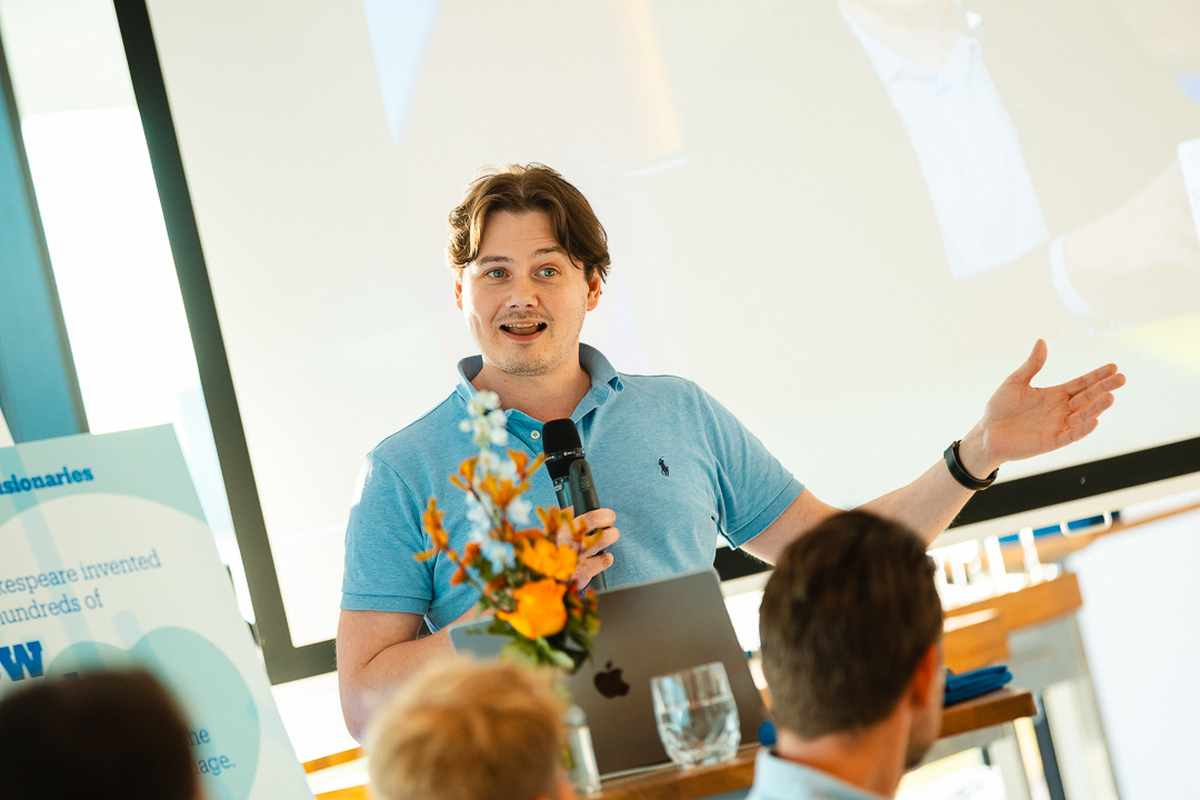
    Tech-expert (1988) gespecialiseerd in kunstmatige intelligentie en mede-oprichter van ai.nl, The Automation Group, Proxies en eBrain.ai. Oud-hoofdredacteur van diverse zakenmerken en daardoor een geoefend verteller op het podium en in de media. Verzorgt jaarlijks 150+ AI-keynotes in binnen- en buitenland en is gastdocent aan Nyenrode. Co-auteur van zeven boeken, waaronder 'Handboek AI Strategie' en 'AI Agents', en bekend als presentator op radio en RTL Z. Reist langs de labs van OpenAI, Nvidia en Tencent en vertaalt de nieuwste doorbraken naar inzichten die leiders direct kunnen toepassen.

    LinkedIn
    // GET STARTED// How we can help

    Beyond reading — let AI work for you.

    // CONTINUE READINGAll articles

    More from AI Trends.

    Newsletter

    Always up to date on AI.

    Once a month: cases, frameworks and concrete examples of what works in practice. No noise.

    No spam. Unsubscribe any time.