

We value your privacy

    We use cookies to analyse traffic, improve our website and show relevant content. You choose what we may use. Read our privacy policy.

    Live AI news
    Back to articles// AI Fundamentals

    Why Agentic AI Is Not by Definition Cheaper or More Efficient Than Human Labor

    Agentic AI is not always inherently more efficient than human labor. Sometimes, AI can even prove more expensive, especially when organizations deploy heavy models for simple tasks without making clear strategic choices. As AI is integrated into more business processes, this becomes a fundamental issue.

    Job van den Berg Published 26 maart 2026 Updated 15 juni 2026 4 min read
    De echte vraag is of AI die taak ook tegen de juiste prijs, met het juiste kwaliteitsniveau en binnen de juiste procesinrichting uitvoert.

    Artificial intelligence is often presented as the logical route to increased efficiency. Businesses hear daily that AI speeds up processes, performs work more cheaply, and makes organizations more productive. This quickly creates the idea that if an AI can perform a task, that task is automatically done better, faster, and more economically than by a human. But that is exactly where a major misconception lies.

    AI is not by definition more efficient than human labor. In many cases, AI can even turn out to be more expensive-especially when organizations deploy heavy models for simple tasks without making clear strategic choices. And precisely now that AI is being built into more and more business processes, this becomes a fundamental issue. Once you start using AI at scale, model selection, cost per task, and the design of the collaboration between man and machine become much more important than many companies realize today.

    What we have learned from the latest generation of AI models is that it is tempting to deploy the heaviest and smartest model for everything. That feels safe: after all, you are choosing maximum intelligence, so the quality will likely be the best. However, from a business economics perspective, this is not always wise. If you use the most advanced model for simple emails, standard summaries, minutes, or other routine tasks, costs can escalate quickly. Especially when such a model runs in dozens or hundreds of daily workflows, you are no longer talking about a handy innovation, but about a structural cost item that in some cases becomes more expensive than human effort.

    And that is an important insight: the question is not just whether AI can perform a task. The real question is whether AI performs that task at the right price, with the right level of quality, and within the right process design.

    A good way to understand this is by looking at people. In no healthy company do you automatically assign your smartest and most expensive specialist to every task. You don't ask a scientist to answer emails all day. And you probably don't let the organization's greatest strategic genius write out all the meeting minutes. Not because those people couldn't do it, but because their capacity is simply too valuable to be deployed that way. It is inefficient, expensive, and organizationally illogical.

    It works exactly the same with AI. The most powerful model can often handle the most tasks, but that doesn't mean it's the right choice for all of them. Deploying a heavy model for simple, repetitive actions is essentially the same as using top-tier expertise for work that doesn't require it at all. In that case, you are paying for a level of intelligence that you do not need in practice.

    This is precisely why model selection becomes so important. Not every task requires deep reasoning, advanced analysis, or maximum context processing. Many activities within companies are relatively predictable: standard emails, first drafts of texts, simple customer queries, summaries, classifications, internal searches, or basic reports. For that kind of work, a lighter, faster, and cheaper model is often more than sufficient. Sometimes a human is even still faster, more reliable, or cheaper-especially when a task has little economy of scale or requires strong context, nuance, or responsibility.

    As soon as AI is tested on a small scale, this problem often remains invisible. In pilots, almost everything seems valuable because the focus is primarily on what is technically possible. But once AI is rolled out broadly across the organization, reality changes. Then you deal with massive volumes of prompts, documents, analyses, emails, and interactions. At that point, tokenization, computing capacity, and cost per model suddenly become hard business economic factors. What seemed smart in a demo can prove financially unsustainable at scale.

    Therefore, the real management question shifts. The question of the future is not: how can we use AI? The much more important question is: which model do you use for which task, and when is human effort still the better choice?

    This is not a purely technical issue. It simultaneously concerns strategy, cost control, process design, and quality. Organizations will need to learn to look much more sharply at the nature of the work. How complex is a task really? How great is the impact of errors? How much quality is actually needed? What does the model cost per task, per workflow, and at scale? And where does human involvement still add undeniable value?

    Because that is where the next misunderstanding lies: that AI is primarily about replacement. As if the choice is always between man or machine. In reality, the greatest gain usually lies in the combination. Not everything needs to be done by humans, but certainly not everything should be fully automated. The trick is to design processes so that AI does what AI is strong at, and humans do where humans add value.

    AI is strong in speed, scale, pattern recognition, creating first drafts, and processing large amounts of information. Humans are strong in context, empathy, judgment, creativity, relational alignment, and responsibility. Companies that cleverly combine the two build processes that not only look more modern but actually work better.

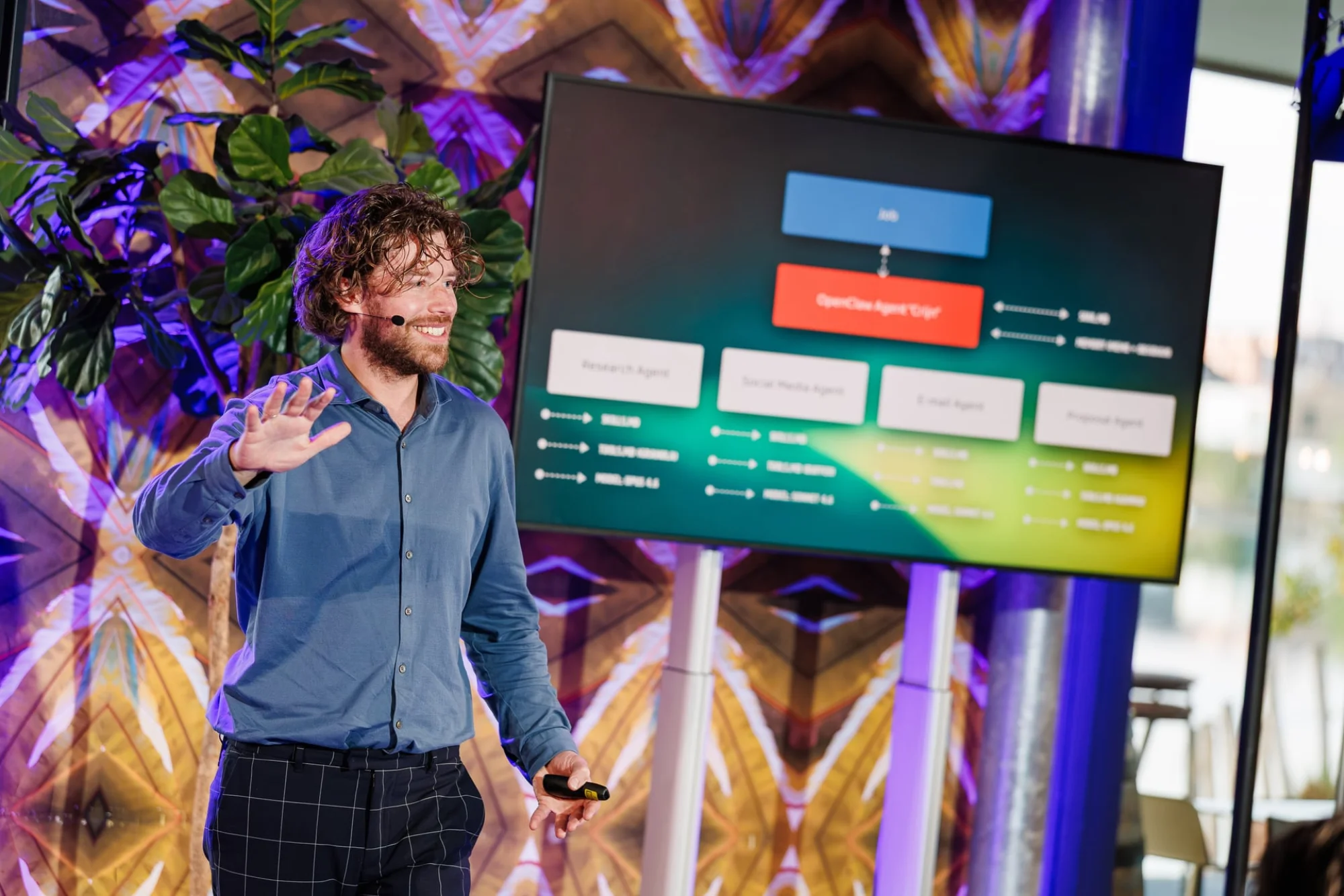
    And exactly there, a new core competency for organizations emerges: AI orchestration. The real winners of the coming years probably won't be the companies that simply put AI on everything, but the companies that understand how to deploy different models smartly, how to control costs, and how to organize the collaboration between man and machine effectively.

    That skill is about much more than just knowing prompts or tools. It is about understanding which model fits which task. When a light model is sufficient. When a heavier model truly adds value. When human oversight remains necessary. And when a task should simply stay with an employee because automation in that case is more expensive or less effective.

    This makes model selection one of the most important skills of the future. Not because technology becomes less important, but precisely because AI is becoming available everywhere. The broader the deployment, the more important it becomes to choose wisely. Organizations that become good at this will not only handle AI smarter but also manage their people, processes, and margins better.

    The future, therefore, does not belong to companies that blindly automate everything. The future belongs to companies that understand that efficiency does not arise from deploying maximum intelligence everywhere, but from choosing the right combination of model, human, and process per task.

    AI can do an incredible amount, but that doesn't mean AI is always the cheapest or most efficient worker. Sometimes it is. Sometimes it isn't. And specifically the ability to make that distinction well will become one of the most valuable competencies of our time.

    Want to get started with AI yourself? Check out our e-learning AI Agents or AI workshops for teams.

    Job van den Berg — Mede-oprichter, AI Keynote Spreker & Techondernemer bij ai.nl

    // About the author

    Job van den Berg

    Mede-oprichter, AI Keynote Spreker & Techondernemer

    Tech-ondernemer (1989) met een achtergrond als socioloog (Research Master (MSc) in statistiek en sociologie) en een van de meest gevraagde keynote sprekers over AI en data in Nederland. Als mede-oprichter van Ai.nl, The Automation Group en Proxies leidt hij engineers die agentic AI van prototype naar productie brengen binnen enterprises. Op het podium vertaalt Job die hands-on praktijk naar concrete strategieën. Eerder was Job Chief Data bij o.a. DPG Media en Kantar. Hij is co-auteur van 5 boeken over AI waaronder 'AI Agents' en 'Handboek AI Strategie' en een veelgevraagd expert in de landelijke media.

    LinkedIn
    // GET STARTED// How we can help

    Beyond reading — let AI work for you.

    // CONTINUE READINGAll articles

    More from AI Fundamentals.

    Newsletter

    Always up to date on AI.

    Once a month: cases, frameworks and concrete examples of what works in practice. No noise.

    No spam. Unsubscribe any time.