The Silent Divide: How AI Is Increasing Inequality in the Workplace
Research from OpenAI, PNAS, and USC Marshall shows that AI is not narrowing existing gaps between colleagues, but widening them. Here is what that means for leaders.
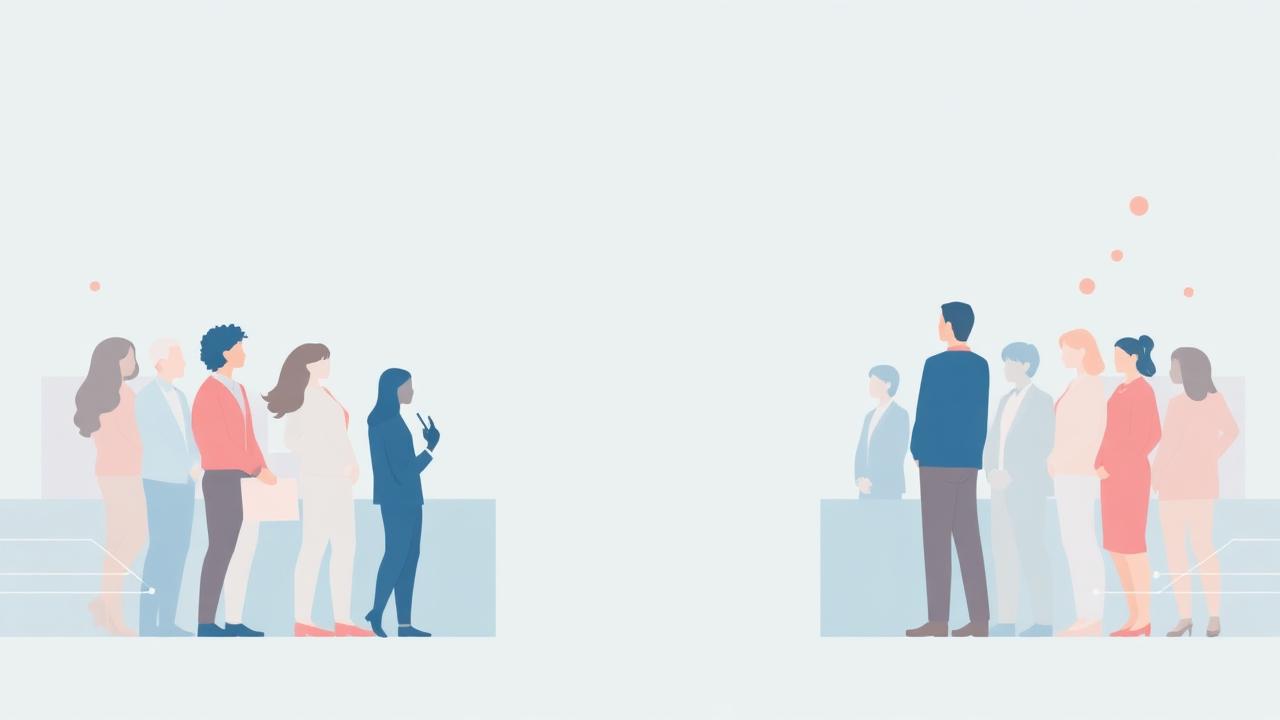
During keynotes and sessions in recent months, we have noticed a shift. Where the audience until recently was largely in the same phase amazement, initial experimentation, questions about what is possible the room is now visibly splitting.
On one side are colleagues who still need to discover what AI actually is. For them, uncertainty prevails: what will change for my profession, for my workday, for my role in two years?
On the other side are people who have been working daily with tools like ChatGPT and Claude Cowork for months. They no longer talk about whether AI adds value they have answered that question but about how they have redesigned their workflows, which models they use for what, and how they get their teams on board.
The distance between these two groups grows every month. And that is not just anecdotal; research is now showing this very concretely.
The Promise versus Reality
In the first months after the launch of ChatGPT, a popular thesis was that AI would level the playing field. Less experienced colleagues would receive extra support from the tool, gaps would shrink, and overall productivity would increase.
For specific, defined tasks, research provides evidence for this think of the work by Brynjolfsson, Li, and Raymond in call centers, or Noy and Zhang with writing tasks. There, AI compressed productivity differences within a defined task.
But anyone following the broader literature sees a different pattern emerging in the workplace: AI actually reinforces existing differences between colleagues instead of dampening them.
What the Research Shows
A six-fold difference within the same company
In December 2025, OpenAI published data on its more than one million business customers. The finding: within one and the same company, the top 5% of AI users send six times as many messages to ChatGPT as the median colleague. For coding tasks, that jumps to seventeen times.
This is not about differences between companies or between industries. This is about differences between colleagues with the same access, in the same team. The infrastructure is available to everyone; the usage differs fundamentally.
Those who use ChatGPT already earned more
A large-scale study in PNAS from 2024 surveyed 18,000 Danish employees across eleven professions where AI is relevant. The uncomfortable conclusion: people who use ChatGPT at work were already earning more before ChatGPT existed.
The adoption of AI is therefore not occurring within the group that could statistically benefit from it the most. It is precisely the people who are already ahead who are also picking up this new layer of productivity. The paper bears a title that leaves no room for doubt: "The unequal adoption of ChatGPT exacerbates existing inequalities among workers."
Within this, another gap stands out: women appear to be sixteen percentage points less likely to use ChatGPT for work even within the same role and with the same employer.
The divide is widening, not shrinking
Research from USC Marshall in 2025 confirms the picture at a macro level. The so-called "GenAI digital divide" between early and late adopters is not shrinking but being further magnified. Younger and more highly educated employees are already deep into the learning curve. Others are still at the starting line. And the pace at which that difference increases is higher than during previous technological transitions.
The belief trap
An arXiv paper from 2024 (Learning to Adopt Generative AI) describes a self-reinforcing mechanism that researchers call the "belief trap." Those who underestimate the utility of AI do not use it. Those who do not use it do not gain the experience that could adjust that judgment. And so, the underestimation and therefore the lag persists.
This is what many leaders are now seeing happen in their own organizations: a group of employees who simply do not get around to experimenting, not because the tools are missing, but because the first encounter was disappointing, or because there seems to be no immediate reason to do so.
Why This Works Exponentially
What makes this gap so unique and allows it to grow so much faster than in previous waves is the exponential nature of AI fluency.
Those who work with new models weekly build an intuition that cannot be learned from a manual. Which prompts work in which context. Which model to use for what. When to do something manually and when to delegate it. That intuition compounds: every experience makes the next experience more valuable.
Erik Brynjolfsson (Stanford) described it in early 2026: a small group of power users automates entire work processes end-to-end and does in hours what takes others weeks.
The laggard doesn't just have less fluency today. They also have less experience upon which tomorrow's fluency can be built. The difference slowly shifts from a learning gap to a fundamental difference in value to the organization.
What This Means for Leaders
The phase where we need to tell people what AI is, is over for more and more organizations. The question currently at play is different: how do you keep everyone in your organization at the same pace?
A few considerations that deserve more attention in this light.
Access is not the same as adoption. The OpenAI report clearly shows that handing out licenses is not a solution. In the same companies with the same tools, factor-6 to factor-17 differences arise. What is missing is usually not the tool, but the structure around its use: peer learning, concrete examples, and regular rhythms where teams experiment together.
Habit, not technology, makes the difference. People who become productive with AI haven't usually studied harder than others; they have tried more often. The threshold to pick it up daily is low, and that alone starts the learning curve. Organizations that consciously facilitate that rhythm for example, with weekly "AI hours" or explicit time to redesign workflows demonstrably reduce the adoption gap.
Visibility into those lagging behind. The PNAS data shows that those falling behind often have a recognizable profile. Older employees, women, and people who were already less visible in the organization before the arrival of AI. Without active attention to those not participating, a divide unintentionally develops that reinforces other existing inequalities.
The time to catch up is evaporating faster than we think. Due to the exponential nature of the learning curve: the later you start, the more there is to catch up on. A training day in a year's time is no longer a solution for those who are not yet participating. The difference is not in knowledge that you transfer in a day, but in hundreds of small experiences that colleagues have already built up in the meantime.
Conclusion
We are past the phase of enthusiastically telling people what is possible with AI. What is currently unfolding within organizations is a silent divide: between colleagues who no longer speak each other's language, between teams that no longer work at the same pace, and between people who will soon no longer be evaluated by the same standards.
The same organization. The same job title. Two different worlds.
The question is no longer whether that difference will arise it is already happening. The question is who within organizations will take responsibility to ensure that the gap does not become irreversible.
Sources
- OpenAI (December 2025). ChatGPT usage and adoption patterns at work. Analysis of usage patterns among over one million business customers.
- Humlum, A. & Vestergaard, E. (2024). The unequal adoption of ChatGPT exacerbates existing inequalities among workers. Proceedings of the National Academy of Sciences (PNAS).
- USC Marshall School of Business (2025). Research on the GenAI digital divide and household adoption.
- Liu, Y., Sun, T., & Wu, X. (2024). Learning to Adopt Generative AI. arXiv preprint 2410.19806.
- Brynjolfsson, E. (February 2026). The AI productivity take-off is finally visible. Financial Times / Fortune.
- Brynjolfsson, E., Li, D., & Raymond, L. R. (2023/2025). Generative AI at Work. NBER Working Paper 31161 / Quarterly Journal of Economics.
- Noy, S. & Zhang, W. (2023). Experimental evidence on the productivity effects of generative artificial intelligence. Science.
Prevent an AI divide in your organisation
The best way to close the gap is to bring everyone along. We help with AI training for teams, a tailored AI Workshop or an AI keynote that gets the whole company moving.

// About the author
Job van den Berg
Mede-oprichter, AI Keynote Spreker & Techondernemer
Tech-ondernemer (1989) met een achtergrond als socioloog (Research Master (MSc) in statistiek en sociologie) en een van de meest gevraagde keynote sprekers over AI en data in Nederland. Als mede-oprichter van Ai.nl, The Automation Group en Proxies leidt hij engineers die agentic AI van prototype naar productie brengen binnen enterprises. Op het podium vertaalt Job die hands-on praktijk naar concrete strategieën. Eerder was Job Chief Data bij o.a. DPG Media en Kantar. Hij is co-auteur van 5 boeken over AI waaronder 'AI Agents' en 'Handboek AI Strategie' en een veelgevraagd expert in de landelijke media.
LinkedIn