The most expensive line on your budget you don't know yet
Why smart executives are learning to steer on token economics now, the new currency of intelligence. An article by ai.nl for leaders who want to govern AI, not be governed by it.
There was a moment, somewhere this year, when AI stopped feeling free. For most companies it arrived quietly, no press release, no warning, just an invoice that was higher than expected and one the next month that was higher still. Hans Scheffer, co-founder of Rotterdam-based HelloPrint, put numbers on it: his company burned through €25,000 in AI tokens in a single week. His message to fellow entrepreneurs was sober: this is becoming serious, as serious as the payroll line in your P&L.
He isn't alone. Salesforce CEO Marc Benioff announced he's heading toward $300 million in AI tokens in 2026. And Uber, not a start-up, but a publicly traded giant, had already burned through its entire 2026 AI budget by April. This isn't a story about tech companies overspending. It's a story about a new economic reality that touches every organization that takes AI seriously.
Tokens: the currency of intelligence
To understand what's happening, you need one concept: the token. An AI model doesn't think in words but in tokens, small pieces of text, the lego bricks of language. Every question you ask and every answer you get back is billed per token. You pay for what you feed the model (input) and for what it gives back (output). The more you let AI read, reason and act, the more tokens flow.
Think of tokens as the currency of intelligence. You used to buy software per user, per month, predictably. Now you buy intelligence per action, and those actions are multiplying fast. That is exactly why this is a boardroom issue, not an IT issue. It hits your margins, your budget and your strategic choices.
The paradox every executive must understand
Here it gets fascinating. Because the price of a token has fallen at a breathtaking pace over the past few years. When the first large language models went public, top-tier intelligence cost around $60 per million tokens. Today you get that same level for a few cents, a drop of roughly a thousand times. Venture capitalists call it 'LLMflation': for equivalent performance, AI gets about ten times cheaper per year, faster than compute ever dropped during the PC revolution.
And yet, the bills keep climbing. How? The answer is deceptively simple: we use so many more tokens that total costs still go up. Cheaper intelligence enables things that were unthinkable before, AI that works autonomously for hours, reads entire dossiers at once, checks its own work and self-corrects. Each of those capabilities multiplies usage. Price per unit falls; the number of units explodes.
The lesson is counter-intuitive but crucial: waiting for it to get cheaper doesn't help. Your usage grows faster than prices fall. The organizations that win aren't the ones with the lowest rates, they're the ones that steer best.
The good news: this is fully steerable
Token economics isn't a natural disaster that happens to you. It's a set of dials you can turn, if you know which ones. It starts with an insight many people miss: there is no such thing as 'the AI'. There's a whole market of models, across every price and capability class. Think of it as a vehicle fleet. There are 'Bentleys', the absolute top models, brilliant but expensive. There's a rock-solid mid-class that handles the vast majority of work perfectly. And there are fast, cheap models that can do surprisingly much. The art is to not run everything through the Bentley but to match each task to the right model. The cost difference between those choices can easily be a factor of ten to a hundred, for virtually the same outcome.
On top of that comes a layer of techniques that intelligently reduce usage, routing that automatically picks the cheapest viable model, and, for organizations that build a lot of software, the option to run certain models on your own infrastructure, keeping your data inside your house.
But perhaps the most powerful lesson comes from Uber. When the budget ran out, the answer wasn't 'turn off the tap'. Instead, every employee got a personal AI budget and a dashboard to track their usage. The effect was subtle but powerful: when people see their own budget, they naturally work more consciously. That is the culture this era demands. Not less AI, but more conscious AI.
From cost line to competitive advantage
This is where the opportunity lies. Tomorrow's edge is not access to AI, soon everyone will have that. The edge is in the discipline to deploy the right intelligence at the right price at the right moment.
Two companies can do the exact same thing with AI and still receive invoices that differ by an order of magnitude. The difference isn't luck and isn't the rate, it's how consciously they steer. The executives who embrace token economics now, as a strategic skill rather than an unavoidable bill, will be the ones still working profitably with AI when others have to hit the brakes.
The question is not whether you will steer on this. The question is whether you do it before the invoice does it for you.
Go deeper, download the white paper
Want to know exactly which dials you can turn? The Automation Group wrote a practical, in-depth white paper: 'The currency of intelligence, grip on your AI costs in the era of agentic AI'. With current model prices, concrete strategies and a decision tree to pick the right model per task.
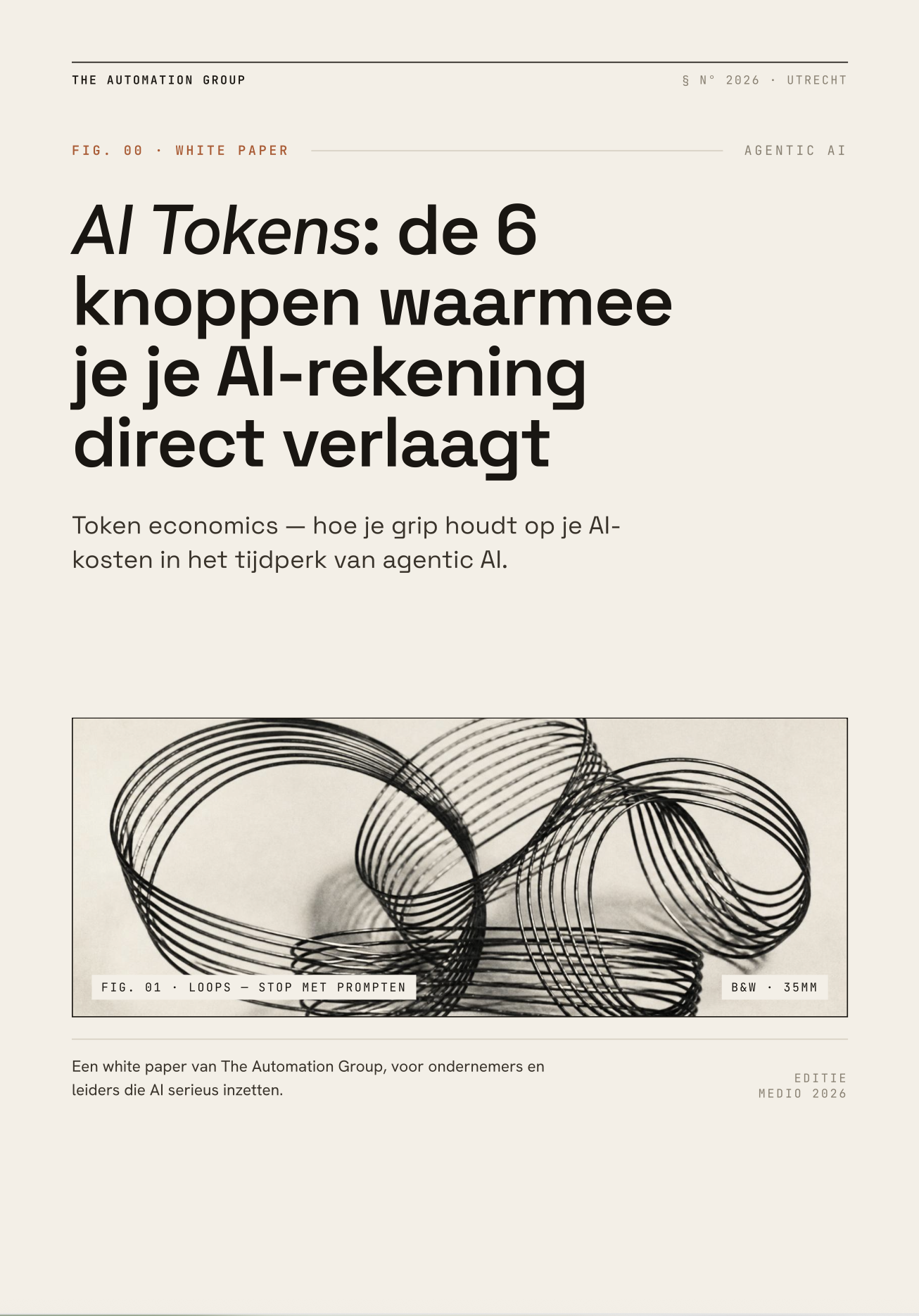
→ Download the white paper for free at theautomationgroup.nl
Want to think this through for your organization? Get in touch with ai.nl, we'll explore together where the biggest lever is for you.
Veelgestelde vragen
What exactly is an AI token?+
A token is the smallest piece of text an AI model reasons with, on average about 3 to 4 letters. Models are billed for both ingested (input) and generated (output) tokens. The more context you provide and the longer the answer, the higher the token usage and therefore the bill.
Why do AI costs rise if the price per token is falling?+
The price per million tokens has dropped about 1000× since 2023 ('LLMflation'), but usage is growing faster. Agentic AI, longer context windows and autonomous workflows mean a single user action can now consume millions of tokens instead of thousands. Net result: the bill keeps climbing.
How do you steer on token economics as an executive?+
Match each task to the right model instead of running everything through the most expensive one, use routing and caching, optimize prompts, and give teams a personal AI budget with visibility into usage. The difference between conscious and unconscious use can easily reach a factor of 10 to 100 in cost.
Is this only relevant for large tech companies?+
No. HelloPrint, Salesforce and Uber are recognizable examples, but every organization that uses AI structurally, from SMB to enterprise, runs into the same dynamic. The earlier you steer consciously, the bigger the margin you preserve once agentic AI goes mainstream.
Where can I find concrete model prices and a decision tree?+
The Automation Group bundled current model prices, strategies and a decision tree in the white paper 'The currency of intelligence'. You can download it for free at theautomationgroup.nl/nl/whitepaper/token-economics.
How does this fit into a broader AI strategy?+
Token economics is one of the pillars of a mature AI strategy, alongside governance, AI literacy and use-case selection. ai.nl helps executives with keynotes, training and consultancy to bring these dials together into a workable approach.
Blijf scherp op AI
Get a grip on your AI costs
Don't let the next AI invoice surprise you. Spar with ai.nl about how to steer consciously on token economics in your organization.
Volgende stap
Bekijk AI Consultancy