Agentic commerce: why companies must now build on two sides
Agentic commerce is the way of purchasing where AI agents search, compare, and conclude transactions on behalf of consumers. It is emerging rapidly, as personal agents like Muse and Dots are gaining popularity at lightning speed. Most companies are only preparing for the business side, with Generative Engine Optimization (GEO). They forget the consumer side: customers who are getting used to buying and transacting via their own agent.
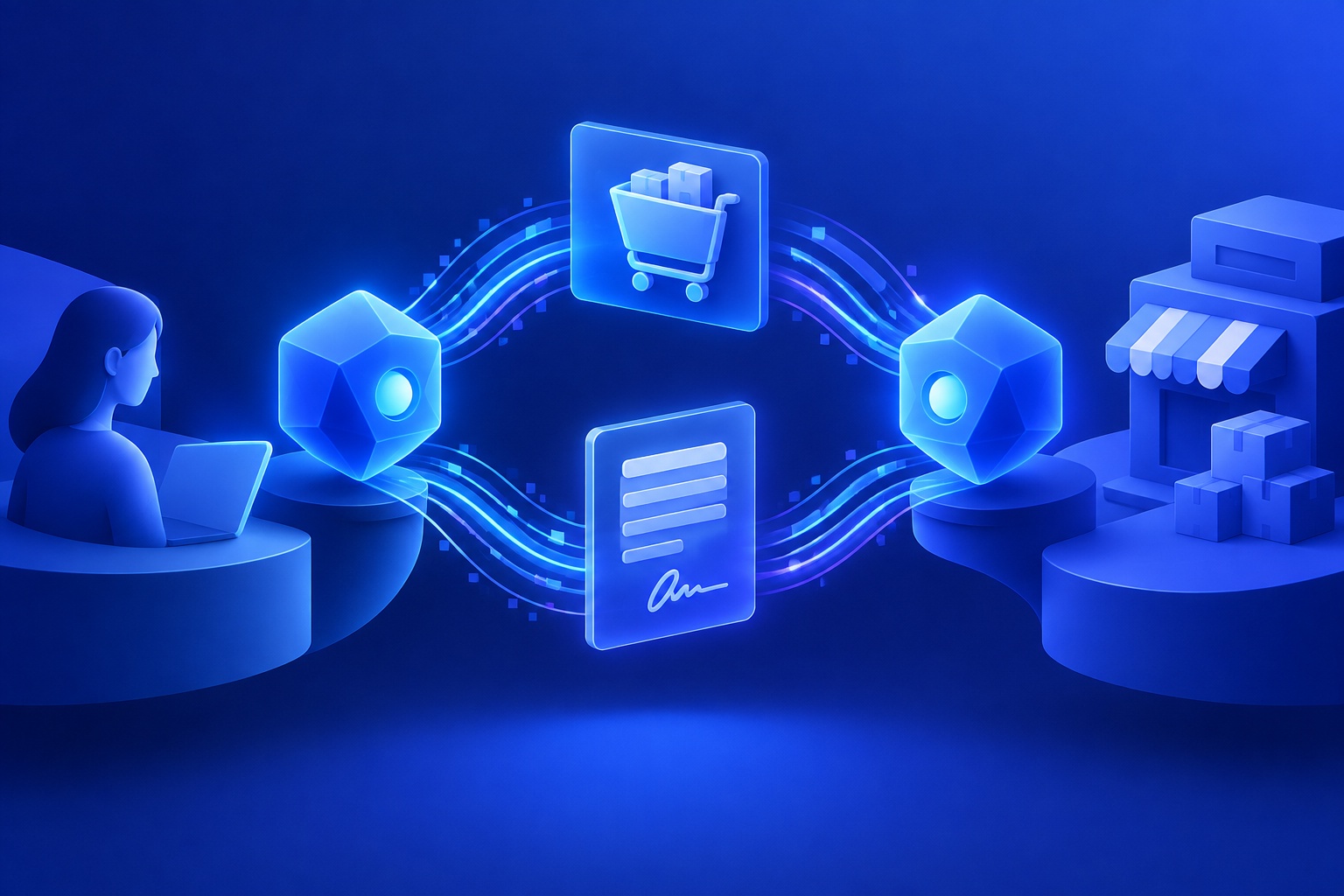
In short: Agentic commerce is the way of purchasing where AI agents search, compare, and conclude transactions on behalf of consumers. It is emerging rapidly, as personal agents like Muse and Dots are gaining popularity at lightning speed. Most companies are only preparing for the business side, with Generative Engine Optimization (GEO). They forget the consumer side: customers who are getting used to buying and transacting via their own agent.
Companies have four options: do nothing, build an in-house AI assistant, connect to LLMs, or become the orchestrator. Our advice: start connecting to LLMs now (option 3) and then continue building towards an in-house assistant (option 2) and the orchestrator role (option 4).
What is agentic commerce?
Agentic commerce is trade where AI agents search, compare, negotiate, and buy on behalf of people and companies. The consumer gives a command, and the agent executes it, from initial research to purchase.
The difference with traditional e-commerce: the customer no longer visits ten websites themselves. An agent does that for them and returns with a single recommendation, or completes the transaction immediately.
An example of a command given to an agent: "Find the best solar panel installation for my house."
Why is agentic commerce emerging so rapidly now?
Agentic commerce is accelerating due to the enormous rise of personal agents. These are AI assistants that not only provide answers but also act on behalf of the user.
- Muse is one such personal agent. Muse is not yet available in the Netherlands, but it shows where the market is heading.
- Dots is another example of a personal agent that arranges tasks and purchases for the user.
The more often consumers use such an agent, the more normal it becomes for them to leave important purchasing decisions to an agent as well. Think of buying a new bicycle, selecting a business software licence, or switching energy suppliers.
How does a purchase via agents work?
With agentic commerce, both consumers and companies act via agents. A purchase takes place in three steps:
- Human: the consumer gives their agent a command, for example, to find the best solar panel installation for their house.
- Agent-to-agent: the consumer's agent searches, compares, reads reviews, and asks questions. The company's agent provides product data, prices, terms and conditions, and evidence, 24/7 and in a machine-readable format. This is where the decision is made.
- Company: the company feeds its agent with its website, reviews, product feeds, terms and conditions, and press coverage.
The consumer chooses based on what their agent advises and also lets the agent act: comparing, requesting, buying. The company's task is to be the answer that the agent finds, trusts, and cites.
What is the blind spot for companies in agentic commerce?
Most companies only prepare for the business side and forget the consumer side. They ensure that AI can find them, but not that they are present where the customer makes decisions via their agent.
The business side: what companies are currently working on
- Generative Engine Optimization (GEO): becoming discoverable in the answers of ChatGPT, Gemini, Perplexity, and other AI search engines.
- Machine-readable product data, prices, and general terms and conditions.
- Structured content, reviews, and evidence that an AI can cite.
The consumer side: what is often forgotten
- Consumers are getting used to buying, requesting, and arranging things via an agent.
- The decision is no longer made on the company's website, but in the conversation between the customer's agent and that of the company.
- Whoever does not play a role there loses the customer relationship, even if their GEO is in order.
Companies must therefore start working on both sides simultaneously now.
What four options do companies have with agentic commerce?
Companies have four strategic options: do nothing, build an in-house AI assistant, connect to LLMs, or become the orchestrator. They primarily differ in who owns the customer relationship.
| Option | Strategy | What it means | Who owns the customer relationship? |
|---|---|---|---|
| 1. Do nothing | Wait and see | Others answer the customer's question. The company only comes into the picture if someone else chooses it. | Another platform or another agent |
| 2. Build an in-house AI assistant | Own channel | The company remains the customer's first point of contact, in its own app and on its own site. | The company itself |
| 3. Connect to LLMs | Join their channel | The company provides its price and terms where customers are already asking their questions, such as in ChatGPT or Gemini. | Shared with the AI platform |
| 4. Become the orchestrator | Middle layer | The company becomes the layer between the customer's demand and the prices and terms of multiple providers. | The company, as the director of the market |
Option 1: do nothing. This feels safe, but it is the biggest risk. Whoever waits leaves the customer relationship to someone else.
Option 2: build an in-house AI assistant. This provides the most control over the customer experience. However, it requires time, investment, and enough users who choose the company's own app over their personal agent.
Option 3: connect to LLMs. This is the fastest route to visibility. The company is immediately present where the consumer is already searching and deciding.
Option 4: become the orchestrator. This is the most strategic role. Platforms, intermediaries, and comparison sites, in particular, can strengthen their position here, as they already stand between the customer and the provider.
What is the advice for companies?
Start with option 3 now: connecting to LLMs. That win can be achieved relatively quickly. From there, continue building towards option 2 (in-house assistant) and option 4 (orchestrator).
Step-by-step plan in five steps
- Make your data machine-readable. Put prices, product specifications, terms and conditions, and evidence into structured, up-to-date feeds that an agent can read.
- Work on GEO. Ensure that AI search engines find, trust, and cite you, with clear answers and reliable sources.
- Connect to the consumer's channels. Offer your price and product in the LLMs and personal agents where customers are already asking their questions.
- Build your own assistant. Use what you learn in step 3 to build an in-house AI assistant, so you remain the first point of contact.
- Grow into the orchestrator role. Become the layer that links customer queries to the offerings of multiple providers.
The core message: companies must develop the business side and the consumer side simultaneously. Merely being found is not enough; you must also be present where the customer's agent makes decisions.
Frequently asked questions about agentic commerce
What is the difference between agentic commerce and e-commerce? In e-commerce, the consumer searches and buys online themselves. In agentic commerce, an AI agent does this on behalf of the consumer.
What is a personal agent? A personal agent is an AI assistant that performs tasks on behalf of the user, such as searching, comparing, planning, and buying. Examples include Muse and Dots.
What is GEO (Generative Engine Optimization)? GEO is the optimisation of content and data so that AI search engines and LLMs find, trust, and cite a company in their answers.
Is GEO enough to be prepared for agentic commerce? No. GEO only covers the business side. Companies must also be present where the consumer decides and acts via their agent.
What should a company do first? Connect to LLMs (option 3), so that price and terms are visible where customers are already asking questions. Then continue building towards an in-house assistant and the orchestrator role.
What happens if a company does nothing? Then others will answer the customer's question. The company only comes into the picture if another platform or another agent chooses it.
How quickly is agentic commerce coming to the Netherlands? Quickly. Personal agents are growing rapidly in usage. Some, like Muse, are not yet available in the Netherlands, but it is expected that this will not take long.
Glossary
| Term | Meaning |
|---|---|
| Agentic commerce | Trade where AI agents search, compare, and buy on behalf of people and companies. |
| Personal agent | AI assistant that acts on behalf of the user, for example, Muse or Dots. |
| Agent-to-agent | The conversation between the consumer's agent and the company's agent, where the decision is made. |
| GEO | Generative Engine Optimization: becoming discoverable and citable in AI answers. |
| LLM | Large Language Model, the language model behind AI assistants like ChatGPT, Claude, and Gemini. |
| Orchestrator | Party that links the customer's demand to the offerings of multiple providers. |
About the author
This article was written by Job van den Berg, co-founder of ai.nl and The Automation Group. We help companies prepare for agentic commerce, on both the business side and the consumer side.

// Over de auteur
Job van den Berg
Mede-oprichter, AI Keynote Spreker & Techondernemer
Tech-ondernemer (1989) met een achtergrond als socioloog (Research Master (MSc) in statistiek en sociologie) en een van de meest gevraagde keynote sprekers over AI en data in Nederland. Als mede-oprichter van Ai.nl, The Automation Group en Proxies leidt hij engineers die agentic AI van prototype naar productie brengen binnen enterprises. Op het podium vertaalt Job die hands-on praktijk naar concrete strategieën. Eerder was Job Chief Data bij o.a. DPG Media en Kantar. Hij is co-auteur van 5 boeken over AI waaronder 'AI Agents' en 'Handboek AI Strategie' en een veelgevraagd expert in de landelijke media.
LinkedIn