Agentic commerce: how to set up your agent distribution channel?
Discover how agentic commerce changes retail and how to set up your agent distribution channel. Explore four options to help AI agents choose your brand.
In short
If you want to be successful in agentic commerce, the crucial question is: how are you going to set up your agent distribution channel? With agentic commerce, an AI agent searches, compares, and buys on behalf of the customer. Consequently, the customer no longer visits your website themselves.
This requires two steps:
- Make your organization agent readable. Ensure that your platforms, data, and information are accessible and readable for AI agents.
- Choose your agent distribution channel. There are four options: do nothing, build your own AI assistant, connect to the LLMs, or become the orchestrator yourself.
Our strategic advice: definitely start by connecting to the LLMs now. This is where potential early gains can be made. Afterwards, build towards your own AI assistant and ultimately the role of orchestrator.
What is agentic commerce?
Agentic commerce is online buying and selling where an AI agent takes over the work of the customer. The customer issues a command. The agent searches, compares prices and conditions, gives advice, and, where platforms support this, completes the purchase.
Until now, the customer searched themselves: googling, comparing, opening tabs, choosing. With agentic commerce, a personal bot does that. Examples of such agents or platforms include ChatGPT, Claude, Gemini, and Muse by Meta.
| Classic e-commerce | Agentic commerce |
|---|---|
| Who searches and compares: The customer themselves | An AI agent on behalf of the customer |
| Where the customer journey starts: Search engine, comparison site, or your own website | A conversation with an AI assistant |
| What determines if you are chosen: Discoverability and persuasiveness towards humans | Whether the agent can find, understand, and compare your offer |
For businesses, this completely changes the target audience. You no longer just need to be findable for people, but specifically for the AI agent that chooses on their behalf.
Step 1: make your platforms, data, and information readable for AI agents
An AI agent can only choose you if it can find, read, and understand your offer. Being agent readable is therefore the prerequisite for everything that follows. In practice, this means:
- Structured data: Products, prices, and conditions are in a machine readable format, such as product feeds and schema.org markup.
- Up to date information: Prices, actual stock, and conditions are accurate at all times.
- Open access: Public information is freely accessible without logging in and without unnecessary blockades.
- Protected API connections: Your systems are accessible via protocols, protecting private and customer info while requiring authentication for sensitive API operations.
| Protocol | By whom | Purpose |
|---|---|---|
| MCP (Model Context Protocol) | Anthropic | Connects AI agents to your data, tools, and APIs. It is an open standard for secure data access, but explicitly not a payment standard. |
| ACP (Agentic Commerce Protocol) | OpenAI and Stripe | Created to enable checkout via an AI assistant, like Instant Checkout directly within ChatGPT. |
| UCP (Universal Commerce Protocol) | Google, with industry partners | Supports the entire buyer journey: from discovery and comparison to checkout and order management. Its scope and integrations continue to evolve. |
In addition to these protocols, it is crucial to realize that not all platforms support payments identically. ChatGPT uses ACP for transactions, Claude uses MCP for data access, Google works with UCP, and Meta's Muse processes payments via Stripe's Link or Shop Pay. Furthermore, Muse always asks for the user's approval before carrying out a purchase or any other sensitive action. This means your distribution strategy may need to differ per channel.
Why now? Muse shows how fast things are moving
Agentic commerce has gained significant momentum since the introduction of Muse, Meta's AI agent. You send Muse a message in the app or via WhatsApp, and the agent helps you achieve goals, like booking trips or placing orders. Importantly, the agent always presents significant steps, such as finalizing a purchase, to the user for verification.
| Date | What happened | Source |
|---|---|---|
| 23/24 November 2026 | Launch in the United Kingdom, with various partners. | Meta |
| 17 November 2026 | Launch of Muse in Australia. | Meta |
| 8 September 2026 | Launch of Muse in the United States via app, web, and WhatsApp. | Meta |
When will Muse come to the Netherlands?
There is no Netherlands launch date confirmed in the official sources reviewed on 27 November. However, we expect adoption in the Netherlands to be rapid once these technologies become widely available. Companies that are not agent readable by then will immediately fall behind.
Step 2: four options for your agent distribution channel
The agent distribution channel is the route by which AI agents find, compare, and purchase your products and services on behalf of customers. We see four options for setting up that channel.
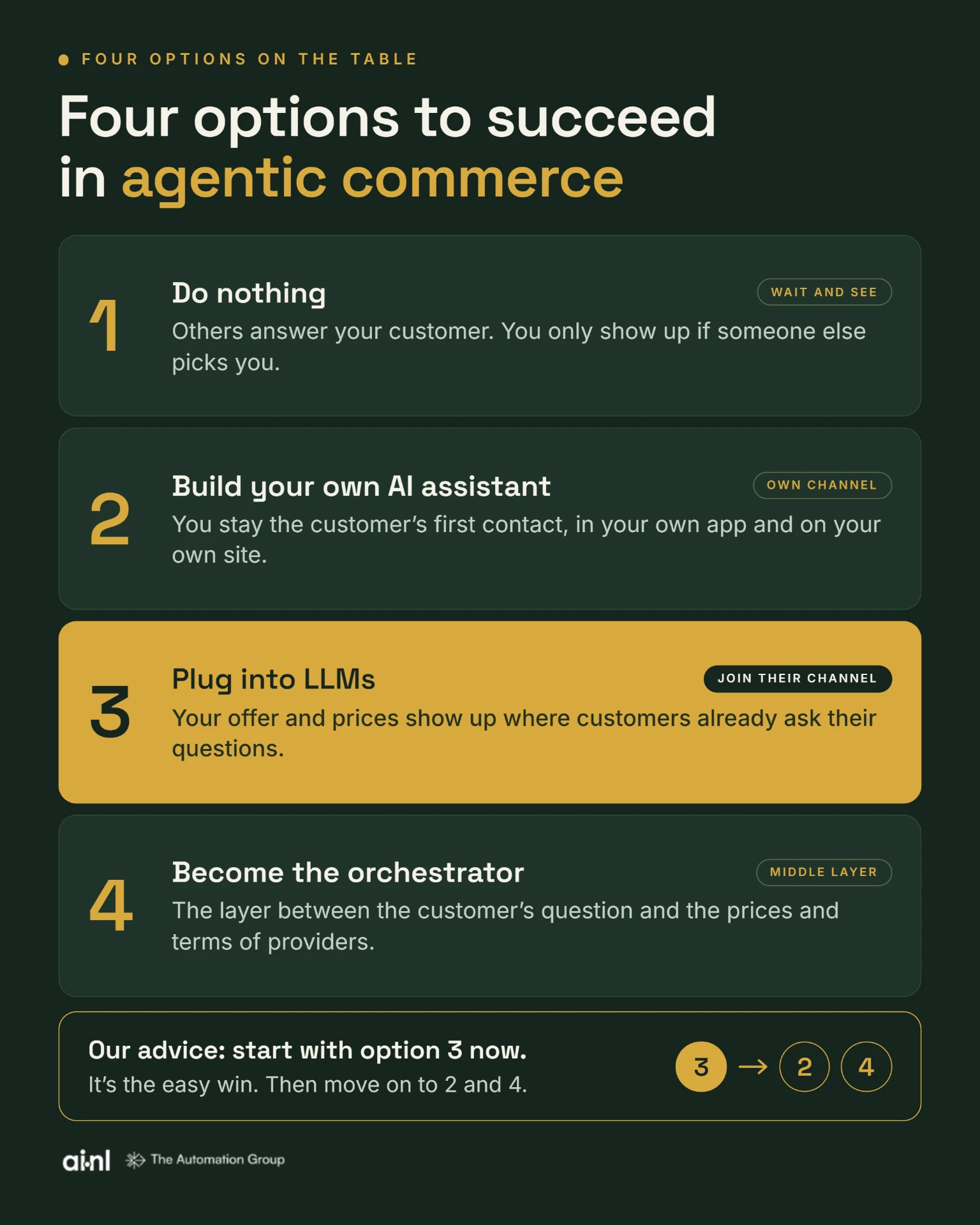
Option 1: do nothing
The AI agent answers your customer's question based on what it happens to find from others. You only come into the picture if someone else includes you as a source. You have reduced influence on how your product is presented.
Option 2: build your own AI assistant
You offer customers a smart assistant in your app or on your site. This keeps you as the first point of contact. However, whether you truly retain ownership of all collected data is not guaranteed. That entirely depends on the arrangements you make with your chosen technology providers. Moreover, this requires significant investment, and consumers still have to find their way to your website themselves.
Option 3: connect to the LLMs
You ensure that your products, prices, and conditions are immediately available and structured for the major AI platforms. This positions you exactly where consumers are already asking questions. This option can yield potential gains and rapid visibility, though immediate direct sales are never guaranteed because the final decision occurs in the platform's interface.
Option 4: become the orchestrator
You become the layer between the abstract demand of the customer and the supply from countless different providers. You are the platform that aggregates, compares, and presents the inventory. In our strategic opinion, it is the most valuable, but at the same time the most complex and ambitious role.
The four options compared
| Option | Your role | Advantage | Disadvantage |
|---|---|---|---|
| 1. Do nothing | Wait and see | Requires no investment right now | Reduced influence on how your product is explained or compared |
| 2. Own AI assistant | Own channel | Opportunity to keep relationships strong | Requires investment, and customers still need to find you themselves |
| 3. Connect to LLMs | Present in their channel | Potential quick wins and high visibility | Customer contact runs through a third party platform |
| 4. Become the orchestrator | Intermediary layer between supply and demand | Generates the most structural value in our opinion | The most ambitious and technically demanding route |
Our advice: start with option 3
Our explicit strategic advice is to maintain the following fixed developmental sequence:
- Now: connect to the LLMs (option 3). Make your products, prices, and conditions directly accessible and readable for the major AI platforms. This is where you can take the first indispensable steps and learning moments.
- Next: build your own AI assistant (option 2). Create an optimized touchpoint to serve loyal customers, while making clear agreements about data ownership.
- Finally: become the orchestrator (option 4). Develop the capabilities to include the offerings of others and become the indispensable link in the market.
Doing nothing is also a choice. However, others will then determine whether the customer ever encounters you again.
Frequently asked questions about agentic commerce
What is agentic commerce?
Agentic commerce is online buying and selling where an AI agent searches, compares, and orders on behalf of the customer, where supported. The customer merely issues a command; the agent executes the necessary steps.
What is an agent distribution channel?
An agent distribution channel is the route through which AI agents find, compare, and purchase your products and services on behalf of customers. This exists alongside your conventional webshop, search engines, or external marketplaces.
What does agent readable mean?
Agent readable means an AI agent can independently interpret your offering. This requires open access to public product info via robust structured data, up to date prices, and protected transactions via secure API connections and protocols like MCP, ACP, and UCP where customer information remains private.
Which of the four options should you choose first?
Start by connecting to the LLMs (option 3) for the most initial traction and potential visibility. After that, work towards your own AI assistant (option 2) and ideally ultimately to a role as an orchestrator (option 4).
What is the difference between your own AI assistant and connecting to LLMs?
With an own assistant, the customer navigates to your app or website, ensuring you remain the point of contact. If you connect to the LLMs, you proactively bring your offering to external platforms like ChatGPT, Claude, Gemini, or Muse, exactly where the consumer starts their search.
What is an orchestrator in agentic commerce?
An orchestrator is the overarching technical and commercial layer between consumer needs and the fragmented supply of various providers. The orchestrator aggregates this supply and directs the purchase for the agent.
Is Meta's Muse already available in the Netherlands?
No Netherlands launch date is confirmed in the official sources reviewed on 27 November. However, the technology is progressively rolling out in multiple parts of the world.
Official Sources
- Meta: Introducing Muse: The World's First Personal AI Agent Built for Everyone (8 September 2026)
- Meta: Muse is now available in Australia (17 November 2026)
- Meta: Introducing Muse in the UK: A Personal AI Agent You Control (23/24 November 2026)
- OpenAI: Buy it in ChatGPT: Instant Checkout and the Agentic Commerce Protocol (29 September 2025)
- Google: Under the Hood: Universal Commerce Protocol (11 January 2026)
- Anthropic: Introducing the Model Context Protocol (25 November 2024)
Want to know more about how to prepare for this technology? Check out our services for AI consultancy and GEO optimization.

// About the author
Job van den Berg
Mede-oprichter, AI Keynote Spreker & Techondernemer
Tech-ondernemer (1989) met een achtergrond als socioloog (Research Master (MSc) in statistiek en sociologie) en een van de meest gevraagde keynote sprekers over AI en data in Nederland. Als mede-oprichter van Ai.nl, The Automation Group en Proxies leidt hij engineers die agentic AI van prototype naar productie brengen binnen enterprises. Op het podium vertaalt Job die hands-on praktijk naar concrete strategieën. Eerder was Job Chief Data bij o.a. DPG Media en Kantar. Hij is co-auteur van 5 boeken over AI waaronder 'AI Agents' en 'Handboek AI Strategie' en een veelgevraagd expert in de landelijke media.
LinkedIn