The 10x Organization: How AI Agent Teams are Transforming the Knowledge Worker
In the 10x organization, the metric shifts from hours to impact. Token budgets become the new salary component and agent orchestration the core skill of tomorrow.

The promise of the 10x organization
Imagine: a marketing manager who doesn't run three campaigns per quarter, but thirty. A data analyst who doesn't produce two reports per week, but twenty. A developer who doesn't write one hundred lines of code per day, but a thousand. This is not science fiction. This is the reality of the 10x organization.
The term refers to organizations in which individual employees, supported by teams of AI agents, deliver the output and impact previously only achievable by entire departments. Not by working harder, but by orchestrating smarter. The knowledge worker of tomorrow is no longer an executor, but a conductor of intelligent systems.
Sam Altman, CEO of OpenAI, predicts that we will soon see the first one-person company with a billion-dollar valuation something that would have been unthinkable without AI.
From hours to impact: a paradigm shift
For decades, organizations have measured productivity in hours. The 40-hour workweek model, born in the Industrial Revolution, has remained the standard for knowledge work. But this model is fundamentally broken when we talk about AI-supported work.
In the 10x organization, the metric shifts from input (hours per week) to output (deliverables, quality, impact). An employee who delivers a complete market analysis in four hours with the help of AI agents-a task that previously took two weeks-is not judged on the four hours, but on the value of that analysis.
The new productivity formula
The formula for productivity in the 10x organization is fundamentally different:
- Traditional: Productivity = output / hours worked
- 10x model: Impact = (human creativity + AI capacity) × orchestration skill
This has far-reaching consequences. When output is no longer linked to hours, the logic of hourly rates, fixed working hours, and physical presence lapses. What remains is a purer question: what value are you creating?
PwC research confirms this shift: productivity growth has nearly quadrupled in sectors most exposed to AI since 2022. Employees with advanced AI skills earn an average of 56% more than colleagues in the same roles without those skills.
Token budgets: the new salary component
This is where it gets really interesting. If AI agents do the heavy lifting, and those agents run on language models billed per token, then the token budget becomes a crucial resource. Just as important as the salary, and perhaps more important than the laptop.
What are token budgets?
A token budget is the amount of computing power an employee has at their disposal to deploy AI models. Think of it as a monthly credit with which you direct your team of AI agents. The larger your budget, the more agents you can run, the more complex tasks you can tackle, and the more impact you can make.
The costs are real and scale quickly. A proof-of-concept costing fifty dollars in API usage can escalate to hundreds of thousands of euros per month in full production deployment.
Token budgets as remuneration
The most forward-thinking organizations are already experimenting with token budgets as part of the compensation package. The idea is simple but revolutionary:
- Base salary: compensation for human expertise, creativity, and judgment
- Token budget: the ability to deploy AI agents, tailored to role and responsibility
- Impact bonus: performance-related pay based on actual value created
A senior strategist receives a larger token budget than a junior employee, not because they work more hours, but because they are capable of orchestrating more complex agent teams and generating more value.
The model selection challenge
Not all tokens are equal. A token on a frontier model like Claude Opus or GPT-4.5 costs a multiple of a token on a smaller model. The art is to deploy the right model for the right task:
- Frontier models (high cost, high capacity): for complex reasoning, strategic analysis, and orchestration
- Mid-tier models (average cost): for standard knowledge work, content creation, and data analysis
- Small language models (low cost, high speed): for routine tasks, classification, and high-frequency use
The so-called Plan-and-Execute pattern where a frontier model plans and cheaper models execute can reduce costs by 90% compared to deploying the most expensive model for everything.
The skills of the knowledge worker of tomorrow
If token budgets are the fuel, then orchestration skills are the steering wheel. The knowledge worker of tomorrow needs a fundamentally different competence profile.
1. Model evaluation
Which model is best for which task? This requires an understanding of benchmarks, but primarily practical experience. A model that excels in creative writing is not necessarily the best for data analysis. The 10x employee knows which model to use when and can systematically evaluate quality, speed, and cost.
By 2026, there will be more than twenty LLM orchestration frameworks and evaluation suites. The knowledge worker doesn't need to be an ML engineer but must understand the landscape and make informed choices.
2. Agent orchestration
Orchestration is the heart of the 10x organization. It involves the ability to coordinate multiple AI agents, divide tasks, monitor quality, and merge results into coherent work.
Think of a project manager who no longer manages a team of fifteen people, but a team of fifteen specialized agents. One agent does market research, another writes content, a third analyzes data, and a fourth builds presentations. The human defines the strategy, sets quality criteria, and intervenes where necessary.
3. Prompt engineering and context management
The way you formulate an assignment for an AI agent largely determines the quality of the result. Context management the ability to provide relevant information to the right model at the right time becomes a core competency.
4. Quality control and risk management
AI agents make mistakes. They hallucinate. They misinterpret instructions. The human knowledge worker is the quality layer that ensures output is reliable, accurate, and usable. This requires domain knowledge, critical thinking, and the ability to validate AI output.
From practice: cases and evidence
Cursor: $100 million in revenue with fewer than sixty people
The most telling example of the 10x organization is Cursor, an AI-native code editor. The company grew from zero to one hundred million dollars in annual recurring revenue in just twelve months the fastest ever for a SaaS company. All with a team of fewer than sixty people, without a marketing budget.
Cursor is built around the principle that AI is not an add-on, but the core of the product and the organization. Every employee functions as a 10x worker, supported by AI systems that replace the work of many colleagues.
What we see daily at The Automation Group
At The Automation Group, we see this transformation in practice every day. Our teams work with specialized AI agents that take over tasks previously performed by entire departments. A single consultant can now, supported by a well-orchestrated team of agents, deliver the output of an entire project team.
The key is not technology alone, but the combination of domain expertise, orchestration skill, and the right token budget. We see that employees who master this combination consistently make two to ten times more impact than colleagues who still work traditionally.
Organizational change according to Gartner
Gartner predicts that by 2026, twenty percent of organizations will use AI to flatten their structure, with more than half of current middle management positions disappearing. Meanwhile, IDC expects AI copilots to be embedded in nearly eighty percent of all enterprise workplace applications.
But there is nuance. More than forty percent of current agentic AI projects are at risk of being canceled by 2027 due to unexpected costs, complexity, or risks. The organizations that succeed are those that fundamentally redesign their structure, not those that layer AI on top of existing processes.
The way forward: five principles for the 10x organization
- Measure impact, not hours. Redefine productivity metrics around output and value creation. Let go of the time clock.
- Invest in token budgets. Make AI computing capacity an explicit part of the compensation package. Give employees the means to run their agent teams.
- Train on orchestration skills. Model evaluation, prompt engineering, and agent management become core competencies. Invest in these as you would invest in leadership development.
- Redesign the organization. Don't stick AI as a layer on top of existing processes. Rethink roles, structures, and workflows through the lens of human-agent collaboration.
- Start now, but start smart. Organizations experimenting with agent orchestration now are building a lead that is difficult to bridge. But do it with a clear cost and quality strategy.
Conclusion
The 10x organization is not a utopia. It is an organizational model that is already working at companies like Cursor and teams like those at The Automation Group. The core is simple but transformative: give talented people the right AI tools and orchestration skills, and they deliver the work of entire teams.
Metrics change: no longer hours in the week, but impact. Compensation changes: token budgets become as important as salaries. Skills change: model evaluation and agent orchestration become core competencies.
The question is not whether this transformation is coming. The question is whether your organization is ready for it.
Want to get started with AI yourself? View our e-learning AI Agents or AI workshops for teams.
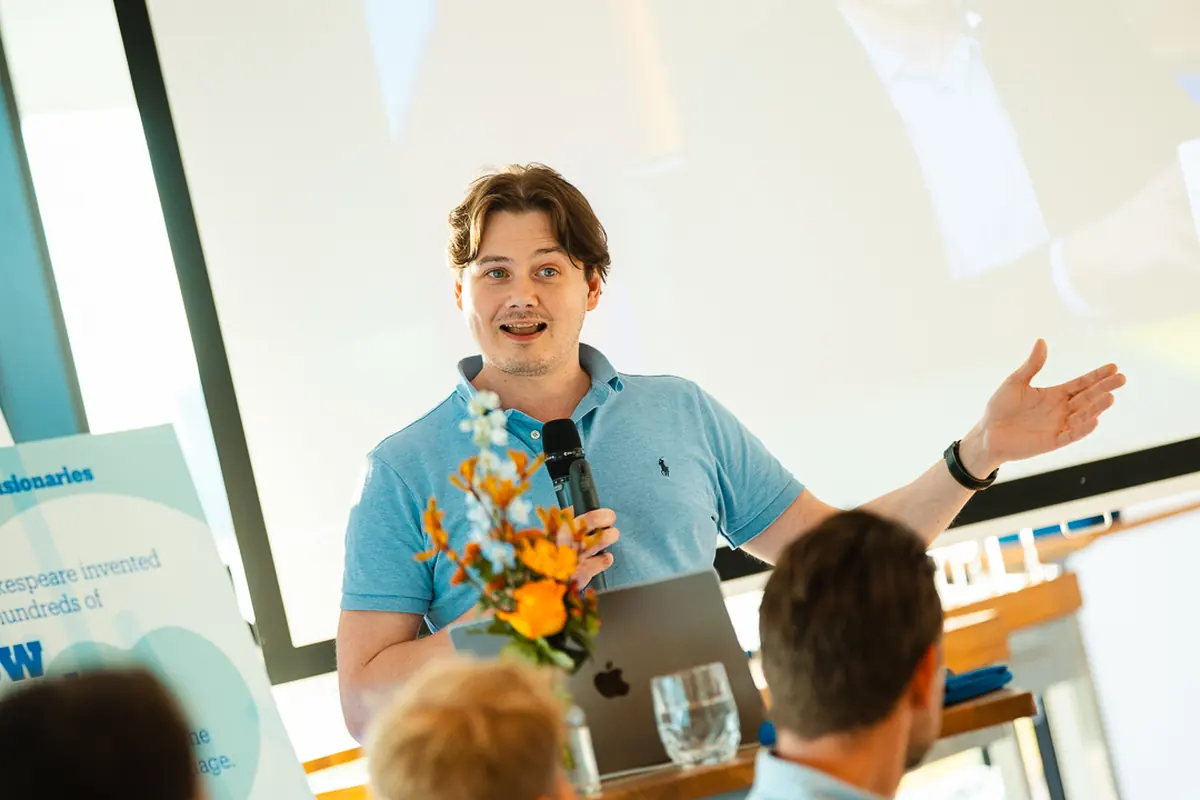
// About the author
Remy Gieling
Mede-oprichter, AI-expert & bestseller-auteur
Tech-expert (1988) gespecialiseerd in kunstmatige intelligentie en mede-oprichter van ai.nl, The Automation Group, Proxies en eBrain.ai. Oud-hoofdredacteur van diverse zakenmerken en daardoor een geoefend verteller op het podium en in de media. Verzorgt jaarlijks 150+ AI-keynotes in binnen- en buitenland en is gastdocent aan Nyenrode. Co-auteur van zeven boeken, waaronder 'Handboek AI Strategie' en 'AI Agents', en bekend als presentator op radio en RTL Z. Reist langs de labs van OpenAI, Nvidia en Tencent en vertaalt de nieuwste doorbraken naar inzichten die leiders direct kunnen toepassen.
LinkedIn