Claude Code Dispatch vs Codex Mobile: Which AI Coding Agent to Command from Your Phone?
Anthropic and OpenAI launched mobile coding agents within weeks of each other. While Claude Code Dispatch and Codex in the ChatGPT app share similarities, their architecture, ecosystems, and target audiences differ. Here is a factual comparison of their actual capabilities.
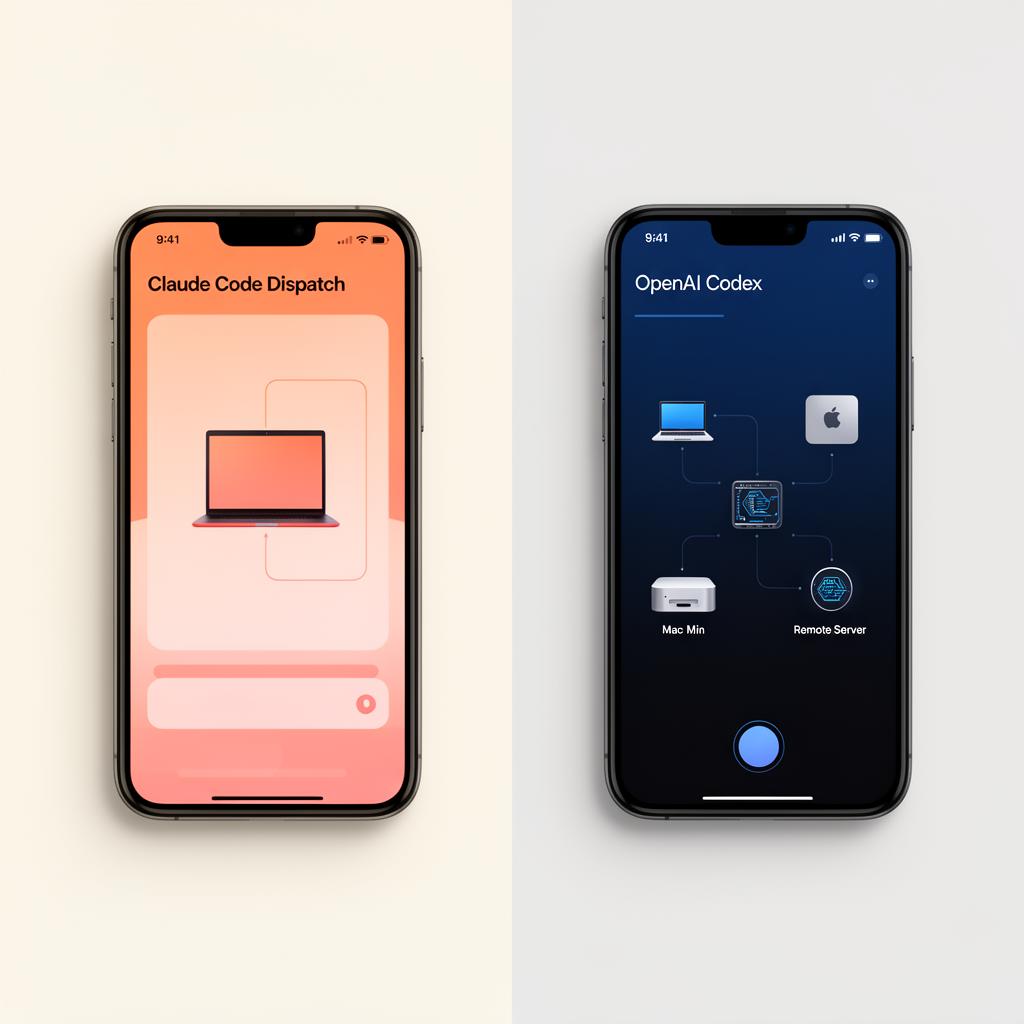
The way developers interact with AI agents is rapidly shifting from the terminal to the pocket. In October 2025, Anthropic introduced Claude Code on the web, followed shortly by Claude Cowork with Dispatch in the mobile app. In May 2026, OpenAI responded with Codex in the ChatGPT mobile app. Both solutions solve the same problem: continuing work on code while away from your laptop. However, their execution differs in several key areas.
What is Claude Code Dispatch?
Dispatch is part of Claude Cowork, a tab in the Claude Desktop app linked to the Claude mobile app. You issue a command to Claude from your phone, and Claude executes it on your own computer at home or in the office. Consequently, the task runs locally-with access to your files, plugins, MCP connectors, and computer use (Claude operating your apps via screenshots and clicks).
The prerequisites are strict: your computer must be powered on, the Claude Desktop app must be running, and you require a Pro or Max subscription (also available for Team and Enterprise with premium seats since November 2025). It operates on macOS and Windows x64. Cowork remains in beta at the time of writing.
How Dispatch Works in Practice
- A single continuous conversation that synchronizes between phone and desktop
- Claude continues working on your local machine even when you are not viewing the screen
- Mobile notifications as soon as a task is completed or requires input
- Full access to local files, MCP connectors, and computer use
What is Codex Mobile?
OpenAI's version is built into the existing ChatGPT app on iOS and Android. Codex Mobile is not a standalone app but a new mode within ChatGPT. It connects to the machine where Codex is running-your laptop, a dedicated Mac mini, or a managed remote environment via Remote SSH. As with Dispatch, your phone acts as the remote control while the heavy lifting occurs on that computer.
A key architectural element: OpenAI utilizes a secure relay layer that makes your trusted machines accessible without exposing them directly to the internet. The ChatGPT app loads the live state of the linked environment and synchronizes threads, approvals, screenshots, terminal output, and diffs back to your phone in real time.
How Codex Mobile Works in Practice
- Available on all plans, including Free and Go
- iOS and Android, no separate download required (integrated into the ChatGPT app)
- Management of multiple active threads and sessions within your linked environment
- Live updates of screenshots, terminal output, test results, and diffs
- Computer Use supported: control desktop apps and logged-in websites via Chrome from your phone
- Remote SSH integration for managed remote development environments
Important to note: Codex Mobile controls one environment at a time. You can switch between multiple machines running Codex, but your phone serves as a single remote control for the active session-not as a dashboard for controlling multiple computers in parallel.
Seven Key Differences at a Glance
1. Target Audience and Pricing
Codex Mobile is available for free to anyone with a ChatGPT account, including Free and Go. Claude Code Dispatch requires a Pro or Max subscription (starting at approximately $20/month) or a Team/Enterprise premium seat. For solo developers or teams already using ChatGPT, OpenAI presents a lower barrier to entry.
2. Ecosystem and Distribution
Codex is integrated into an app that hundreds of millions of people already have installed. Dispatch requires two separate apps from Anthropic (desktop and mobile) that must be installed and linked separately. This makes onboarding significantly simpler for OpenAI.
3. Requirements and Always-On
Both products require your computer to be awake and running the corresponding app. Codex adds official support for remote computers and Mac minis as always-on workstations, plus Remote SSH for managed cloud environments. Dispatch is specifically designed for your primary workstation.
4. Security and Networking
Anthropic does not require open ports-the Desktop app initiates the connection with Anthropic's infrastructure. OpenAI explicitly documents a relay layer that synchronizes session state and context without making your machine externally reachable. This transparency is beneficial for security teams during reviews.
5. Computer Use and Local Apps
Both products support computer use on the linked machine. Claude Cowork preceded OpenAI in this regard, with OpenAI following with Codex Mobile, which can control desktop apps, work within logged-in websites via Chrome, and locate or use files on your machine. In practice, Anthropic's computer use is currently slightly more mature; OpenAI's implementation is more widely deployed but newer.
6. Multi-thread Workflow
Codex Mobile is designed to manage multiple sessions on your linked environment in parallel-fixing a PR, updating a slide deck, and continuing an existing thread can occur simultaneously. Cowork follows the philosophy of one continuous conversation synchronizing between phone and desktop. The preferred approach depends on whether you prefer fragmented parallel work or maintaining a single long context.
7. Enterprise Features
OpenAI simultaneously launched programmatic access tokens (for CI pipelines), Hooks for scanning prompts and logging conversations, and HIPAA-compliant usage in local environments for ChatGPT Enterprise. Anthropic has made Cowork available for Team and Enterprise since November 2025. For highly regulated sectors, OpenAI's enterprise stack is currently more developed.
When to Choose Each?
Choose Claude Code Dispatch if...
- You already use Claude Pro or Max and your workflow is built around Claude
- You value a single continuous context between phone and desktop
- You use computer use extensively and want the most mature implementation
- You want a simple setup without SSH configuration or relay tokens
Choose Codex Mobile if...
- You already work within the ChatGPT ecosystem and do not want an extra subscription
- You want to test a free entry point before committing to a paid plan
- Your teams run in managed remote environments with Remote SSH
- You require enterprise governance (programmatic tokens, Hooks, HIPAA)
- You frequently want to monitor multiple agent sessions in parallel on one machine
What This Means for Your Team
The broader movement is more significant than which tool wins. Coding agents are leaving the terminal and becoming ambient-they continue working while you are in a meeting, getting coffee, or on the road. This changes how development teams organize their workday. Code reviews shift to mobile, decision points become shorter and more frequent, and the skill to direct an agent effectively becomes more important than the skill to solve the entire problem yourself.
For organizations, this means AI coding policies can no longer focus solely on the IDE. You must consider: who is authorized to dispatch from which network, which machines may be accessible remotely, which actions require human approval, and how to collect audit logs centrally. The choice between Claude Cowork and Codex Mobile is therefore not just a selection of tools-it is a choice regarding how you build governance around agents that work continuously.
Conclusion
Claude Code Dispatch and Codex Mobile solve the same user problem from two different starting points. Anthropic optimizes for depth: one conversation, one primary machine, a mature computer-use stack. OpenAI optimizes for distribution and governance: free entry, integrated into a ubiquitous app, Remote SSH, Hooks, and programmatic tokens for enterprise use. Both command a single environment at a time from your phone-claims to the contrary are an overinterpretation of marketing language.
My prediction: within a year, mobile agent control will be a standard expectation, similar to how Slack notifications became standard a decade ago. The question will no longer be whether you use it, but how your team works around it.
Get started with AI coding agents
Want to make your team productive with agentic coding? Check out our Claude training, our Vibecoding training and our AI Agents build projects where we set up agents that actually finish the work.
// About the author
Remy Gieling
Mede-oprichter, AI-expert & bestseller-auteur
Tech-expert (1988) gespecialiseerd in kunstmatige intelligentie en mede-oprichter van ai.nl, The Automation Group, Proxies en eBrain.ai. Oud-hoofdredacteur van diverse zakenmerken en daardoor een geoefend verteller op het podium en in de media. Verzorgt jaarlijks 150+ AI-keynotes in binnen- en buitenland en is gastdocent aan Nyenrode. Co-auteur van zeven boeken, waaronder 'Handboek AI Strategie' en 'AI Agents', en bekend als presentator op radio en RTL Z. Reist langs de labs van OpenAI, Nvidia en Tencent en vertaalt de nieuwste doorbraken naar inzichten die leiders direct kunnen toepassen.
LinkedIn