The Code Factory: Why Europe Risks Missing the Era of Digital Software Production
AI is now writing the vast majority of code at Big Tech, the software factory has been built, and Europe has yet to realize it.

Something fundamental has changed in Silicon Valley. Not gradually, not as a slow shift you see coming over years. No-abruptly, irreversibly, and with a speed that most European boardrooms don't even have on their radar yet. The factory for computer programming has been built. And it is already running.
No one writes code by hand anymore
At the World Economic Forum in Davos, Dario Amodei, CEO of Anthropic, said something that most people treated as a footnote, but which in reality marks a seismic shift: there are engineers within Anthropic who no longer write a single line of code. Not one. They use Claude Code as the backbone-the latest model, the latest tools-and instruct the system to build software. They think about system architecture, about the right instructions, about which sub-agents should deploy which skills. But the code itself? The machine writes it.
This is not an experiment. This is not a pilot. Anthropic confirmed to Fortune that 70% to 90% of all code the company produces is now written by AI. Boris Cherny, the head of Claude Code, said earlier this month that he himself hasn't written code for over two months. And his workflow is telling: he runs five to fifteen parallel Claude Code sessions at once-five in his terminal, five to ten in the browser, plus sessions he starts from his phone in the morning and picks up later. One user on X compared it aptly: it no longer feels like coding; it feels like playing StarCraft-you don't manage code, you command autonomous units.
At Spotify, co-CEO Gustav Söderström mentioned during the last earnings call that the company's top developers haven't written a single line of code since December. They instruct AI via Slack on their phones on the way to the office, merge the results before they sit at their desks, and have rolled out more than fifty new features in 2025 using this workflow.
Let that sink in: the creators of the tools no longer write code themselves.
The factory is felt internally too
We recognize this phenomenon firsthand at The Automation Group. We have a team of forward-deployed engineers-technical specialists who build implementations for clients. Recently, someone internally asked the question: "When was the last time you actually wrote a piece of code yourself instead of instructing an AI system to do it?"
It went quiet. Literally silent.
No one could remember the last time they had manually written a piece of software. Not weeks, but months ago. And our job isn't even to be a full-time programmer-we build business solutions, integrations, automations. But even we write software. Or rather: we used to write software. Now we instruct machines that do it for us.
That is the point where you realize the shift isn't coming-it's already here.
The numbers behind the shift
Anyone who thinks this is limited to a few AI labs is mistaken. The figures are sobering and come from the world's largest tech companies:
Satya Nadella, CEO of Microsoft, revealed at Meta's LlamaCon that 20% to 30% of all code in Microsoft's repositories is now written by AI. Microsoft CTO Kevin Scott expects this to reach 95% by 2030. Meta's Mark Zuckerberg expects half of all development work to be done by AI within a year. And Google's Sundar Pichai confirmed that more than 30% of all new code at Google is generated by AI, which has led to an increase in engineering velocity of about 10%.
Jensen Huang, CEO of NVIDIA, put it perhaps most vividly at COMPUTEX 2025: "AI is now infrastructure, and this infrastructure, like the internet, like electricity, needs factories. These factories are essentially what we are building today." And in a conversation with Citadel Securities, he estimated that the market for agentic AI as a labor force will be worth trillions of dollars, with digital nurses, accountants, lawyers, and marketers supplementing the workforce. At NVIDIA itself, there are already more AI agents working on cybersecurity than humans.
Huang's prediction: "The IT department of every company will become the HR department for AI agents." That is not a metaphor. That is an operational model.
The labor market paradox
And here is where it gets painful. Because while these factories are running, more people in America are graduating in computer science than ever before-the number of bachelor's degrees doubled from 51,696 in 2013 to 112,720 in 2023. But the job market has collapsed.
A breakthrough study from Stanford University, led by economist Erik Brynjolfsson, analyzed millions of salary records and found a nearly 20% decline in employment for software developers aged 22 to 25 since the launch of ChatGPT in late 2022. Entry into AI-exposed professions dropped by 13% compared to less-exposed professions like nursing. Unemployment among computer science graduates stands at 6.1% in 2025-nearly double that of philosophy graduates.
Jan Liphardt, professor of bioengineering at Stanford, summarized it: Stanford computer science graduates are struggling to find entry-level jobs at major tech companies. That is insane.
And here lies the paradox. Why? Because the factories don't need operators-they need architects. AI can perform the structured, repetitive tasks that previously served as a training ground for junior developers. But to direct the factory effectively, you need years of experience with unexpected problems, complex systems, and messy real-world scenarios. The Stanford study confirms this: for experienced developers, employment remained stable or even grew. It is the beginners who are disappearing.
The language of machines turns out not to be that difficult. But knowing what the machines should say-that requires depth.
The return of a burnt-out developer
Take the story of the founder of Open Claw-once a respected software developer who built a famous framework years ago, then lost his love for software, and did something else for years. When he returned, he didn't do it by relearning how to code in the classical sense. He started vibe-coding. Attempt after attempt, iteration after iteration-until, on attempt 44, he launched Open Claw: the first general-purpose, personalized AI agent that you could install as a product. Open Claw was a massive success. The product was entirely vibe-coded. No handwritten architecture, no team of dozens of developers. One person with a vision, and a machine that wrote the code.
OpenAI has since acquired the project. OpenAI's founder predicted that 80% of all applications will eventually be created via vibe coding. And this isn't just about hobby projects or prototypes. We are talking about production-grade software, SaaS applications, mission-critical systems.
According to the 2025 Stack Overflow Developer Survey, 65% of all developers now use AI coding tools weekly. This is not the future. This is the present.
The analogy we must understand
Think of the textile industry before the Industrial Revolution. Clothing was made by people at looms-manually, artisanally, limited by the number of hands available. Then came the factory. Not a slightly better version of the loom, but a fundamentally different production system that could generate endless amounts of textiles with a fraction of the human effort.
The same has now happened with software. Anthropic, OpenAI, Google, and a handful of other players have built the digital factory-a system that can produce endless amounts of computer code, directed by a relatively small number of people who instruct and monitor the machines.
Satya Nadella compared it himself to the rise of electricity, noting that it took fifty years before most factories learned how to use electricity to increase productivity. The difference: this time it is moving many times faster.
The paradigm shift that Europe has yet to undergo: these factories are already operational. They are already running.
The flip side: the vampire effect
But let's be honest-it's not all glory. There is a serious downside that receives too little attention.
Steve Yegge, a veteran engineer with over 30 years of experience at Amazon and Google, recently gave a stark warning about what he calls the "vampire effect." In a widely shared blog post, he described how, after long vibe-coding sessions, he suddenly falls asleep-in the middle of the day. His colleagues at his startup seriously considered installing sleep pods in the office. His analysis is sharp: AI excites you, you work like a maniac, you produce enormously-and then it drains you.
"With a 10x productivity boost, one engineer with Claude Code delivers the value of nine additional engineers," Yegge wrote. "But building with AI costs an enormous amount of human energy."
A study by METR confirms this picture. In a randomized study with 16 experienced open-source developers, those using AI tools took 19% longer to complete tasks-even though they estimated themselves to be 20% faster. The tools feel faster, but the reality is more complex. The cognitive load of constant context-switching between sessions, reviewing output, and steering agents is exhausting.
Yegge advocates for engineers to limit their intensive coding sessions to a maximum of three hours a day. Companies that treat their people like factory workers-delivering 10x productivity for eight hours a day-are driving them toward burnout.
Boris Cherny's workflow illustrates this perfectly: yes, he is extraordinarily productive with his fifteen parallel sessions. But he also discards 10-20% of his started sessions because they lead nowhere. And he is likely the world's most experienced user of his own tool. For the average developer, the learning curve is flat but long, as prominent open-source developer Armin Ronacher aptly put it.
The factory produces without a break. The human directing it does not.
Humans in the factory
Let's be real: even in the most advanced physical factories-even in the factories we visited in China-humans are still walking around. Not to operate the machines, no. But because machines sometimes give an error. Because you need humans who understand at a deep technical level how the machine works. Who know which bolt needs replacing. Who have the fundamental knowledge about the software, the hardware, and the system as a whole.
The same applies to these digital factories. Humans are still needed-but humans with a fundamentally different profile. People who check output for quality. Who provide the right instructions. Who handle errors. Who update the models when necessary. Until the models, of course, start doing that themselves. They are system engineers of the highest level. Not operators, but architects and guardians of a self-driving system.
Hiring managers are now saying it out loud: where they previously needed ten engineers, they now need two experienced engineers and an LLM-based agent that are just as productive. Skill requirements in AI-exposed occupations are changing 66% faster than in other sectors, according to the 2025 JetBrains State of Developer Ecosystem report.
The prediction that isn't a joke
It's not a joke when Elon Musk says his team of AI agents at xAI can compete with Microsoft. That those agents can rebuild Excel, PowerPoint, and Word in a heartbeat-but also process company-specific information and provide advice on cybersecurity. It sounds like hyperbole. But the underlying logic is solid: if you have a factory that can produce endless software, building a productivity suite is just an instruction.
And the models have now reached a recursive milestone: they are now substantially helping to build better versions of themselves. OpenAI said of GPT-5.3-Codex that it was "our first model that was instrumental in creating itself." The machines are building the machines that build the machines.
The next abstraction layer
And we are only at the beginning. Right now, these machines are still writing in languages like Python and Java-programming languages once designed so that humans could read and write them. But as Musk also recently predicted: soon machines will simply build machines in machine code. Binary. That is many times more efficient than taking a detour through a human-friendly programming language. We will have interpretation agents showing us what the machines are doing so we can audit them. But the abstraction layer-the distance between what the machine does and what we understand of it-is becoming increasingly thin.
Jensen Huang put it perhaps most beautifully at London Tech Week: AI is the great equalizer. "Very few people know C++ or Python. But everyone knows 'human'." The way you program a computer today is by asking it nicely. And the amazing thing is that the way you program AI now resembles the way you manage a human.
The language of machines was always the exclusive domain of a handful of specialists. That monopoly has been broken. AI models now speak German, French, English, Mandarin, and Greek with ease. It turns out they speak Python, JavaScript, and C# just as easily. The language of machines was harder than human language-but not for machines.
The impact on SaaS and enterprise software
The implications for the software industry are enormous. If 80% of all applications can be built via vibe coding, what does that mean for the thousands of SaaS companies whose reason for existence is derived from the fact that building software is difficult and expensive?
The answer is simple: their moat is evaporating. If an entrepreneur with a clear idea and an AI agent can build a working application in a week and a half-as Boris Cherny's team did with Claude Cowork-then the value of a SaaS product is no longer the code, but the network, the data, and the trust.
Seed-stage startups in the first half of 2025 already had 21% fewer employees than in 2020, according to Carta. These founders are using AI to achieve more with small teams than was previously possible with dozens of people. That is not a trend. That is a structural redefinition of what it means to be a software company.
The urgency for Europe
The main message: don't be complacent. Don't sit back with the idea that it's not that far off yet, or that it will turn out fine, or that the way we've built software for decades is also how we'll do it in the coming years.
The heartbeat of Silicon Valley is the fact that these factories aren't just built, but are being scaled at a blistering pace. In India, infrastructure is being built on a massive scale-a complete AI city in collaboration with America, where tech giants alone are investing $650 billion this year. Google has increased its capital expenditures to $85 billion. Software production capacity is being increased exponentially.
In the meantime, we in Europe must do two things simultaneously. First: empower people within organizations to automate their own work with the tools now available-locally, practically, directly. Second: recalibrate our leadership. The old paradigm, where only a handful of people spoke the language of machines and were thus the gatekeepers of digital innovation, is over.
Sundar Pichai told his own people at Google: "In this AI moment, we have to achieve more by using this transition to realize higher productivity." And he simultaneously expects Google's engineering team to grow-not shrink-because AI makes engineers more effective, not redundant. That nuance is crucial. The job changes; the need for people does not disappear. But the people needed are fundamentally different.
Marc Benioff of Salesforce put it perhaps most confrontingly at Davos: the current generation of CEOs is the last to manage an entirely human workforce.
The real question
The companies that put these digital factories to work will ruthlessly overtake incumbents still programming manually-with incremental software updates, limited by the number of programmers who fit behind a desk from Monday to Friday, nine to five. Not in years. Now.
The constraint is no longer access to compute. The constraint is no longer finding programmers. The old constraint-that only a handful of people spoke the language of machines-has evaporated.
The new constraint is different knowledge: the ability to understand complex systems, formulate the right instructions, perform quality control on the output, and diagnose errors when the machine stalls. And-perhaps most importantly-the human capacity to sustain this without burning out.
The factory is already running. The real question is not whether this is going to happen. The question is whether we jump on the train-or watch from the platform as the competition departs.
Want to get started with AI yourself? Check out our e-learning AI Agents or AI workshops for teams.
// About the author
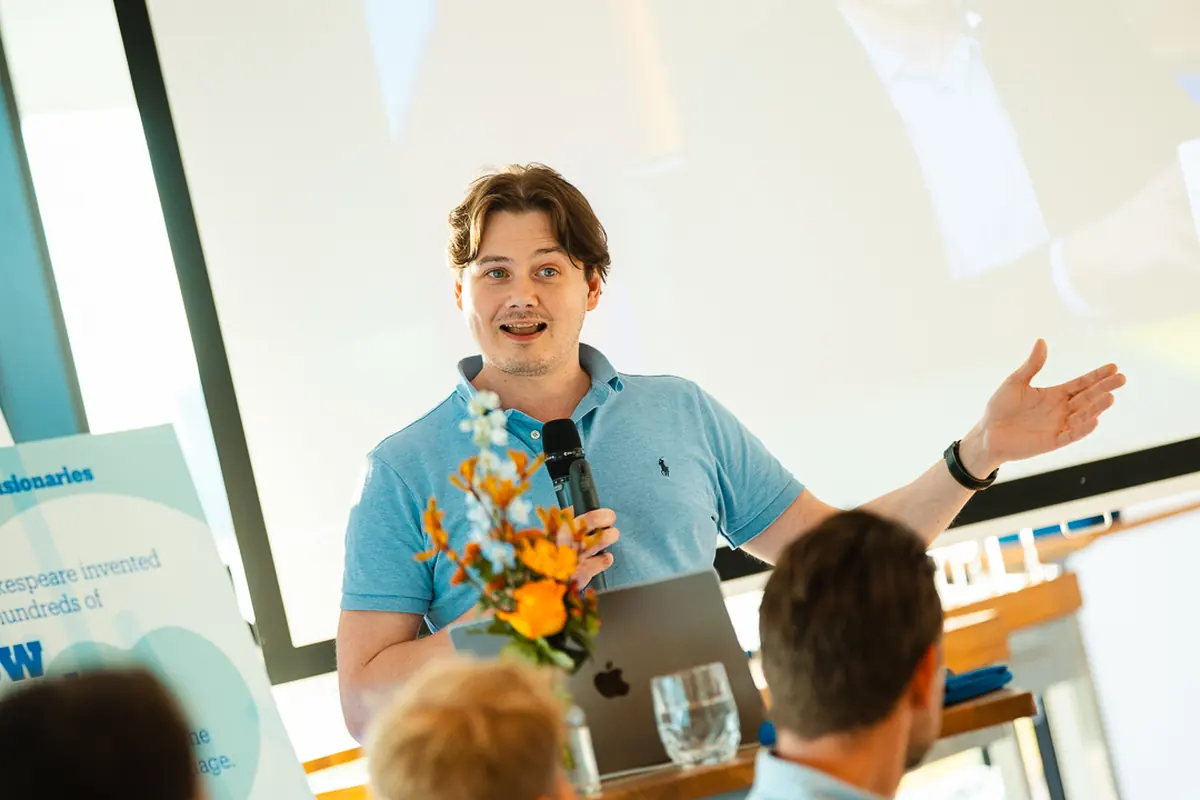
Remy Gieling
Mede-oprichter, AI-expert & bestseller-auteur
Tech-expert (1988) gespecialiseerd in kunstmatige intelligentie en mede-oprichter van ai.nl, The Automation Group, Proxies en eBrain.ai. Oud-hoofdredacteur van diverse zakenmerken en daardoor een geoefend verteller op het podium en in de media. Verzorgt jaarlijks 150+ AI-keynotes in binnen- en buitenland en is gastdocent aan Nyenrode. Co-auteur van zeven boeken, waaronder 'Handboek AI Strategie' en 'AI Agents', en bekend als presentator op radio en RTL Z. Reist langs de labs van OpenAI, Nvidia en Tencent en vertaalt de nieuwste doorbraken naar inzichten die leiders direct kunnen toepassen.
LinkedIn