Silicon Valley versus China: Two Futures of AI, and the Choice Facing the Netherlands
Following two intensive AI research trips-one to the United States, including Silicon Valley, and one to China-we are assessing the landscape. Two countries, two completely different approaches to artificial intelligence. While Silicon Valley thrives on speed, experimentation, and entrepreneurship, China demonstrates what is possible when innovation is centrally steered and deployed at scale. Both systems work, but they operate on different logic-and therein lies the lesson for the Netherlands.

Following two intensive AI research trips, one through the United States, with visits to Silicon Valley among others, and one through China, we are assessing the balance. Two countries, two completely different approaches to artificial intelligence. Where Silicon Valley runs on speed, experimentation, and entrepreneurship, China shows what is possible when innovation is centrally directed and rolled out on a large scale.
Both systems work. But they each steer by a different logic, and therein lies the lesson for the Netherlands.
Those traveling through Silicon Valley feel energy an ecosystem that is constantly in motion.
AI is no longer just technology here, but an infrastructure: something that powers everything from corporate strategy to scientific research. But those who apply the same lens to China see something totally different, and at least as impressive. There, it is not about innovation through experimentation, but about innovation at scale. Where Silicon Valley thrives on openness and speed, China excels in integration and execution. Two extremes that together dominate global AI developments.
And right in the middle: the Netherlands, which is still searching for its own route.
The speed of Silicon Valley: Innovation as a reflex
In Silicon Valley, the pace is staggering. The major AI labs of companies like OpenAI and Anthropic release new models at a rhythm that resembles software versions rather than research breakthroughs. What is impossible today is already solved tomorrow. The conversations there do not revolve around what AI can do, but around how we make it more sustainable, efficient, and reliable. The focus is on optimization: less energy, more performance. Everyone is working on the same stack: from chips to models, from data centers to end-user applications. And what stands out and is different from our trip last year is that the entire ecosystem moves in one direction. The collaboration between hardware manufacturers, model trainers, developers, and investors is tight, not through regulation, but through a shared goal: the acceleration of intelligence. AI is not something "you are going to use"; it is the engine of everything.
The scale of China: Execution as strength
In China, by contrast, it is not the speed of innovation that stands out, but the scale of implementation. Where Silicon Valley builds AI, China applies it, everywhere, simultaneously, and on an unprecedented scale. During the journey through Chinese tech hubs, one thing was particularly striking: the extent to which AI is already woven into society. From smart cities to logistics hubs, from retail to healthcare, everywhere it is about data-driven decision-making. Chinese companies do not wait until the technology is "finished." They build while they implement. Experimentation does not happen in labs, but in the real world. And because the government, industry, and universities work closely together, a flywheel of policy, financing, and execution is created that is difficult to match. Where Silicon Valley thrives on entrepreneurship, China thrives on coordination. The result: an unprecedented speed of adoption, but often less room for fundamental reflection or ethical counter-pressure.
Two systems, two logics
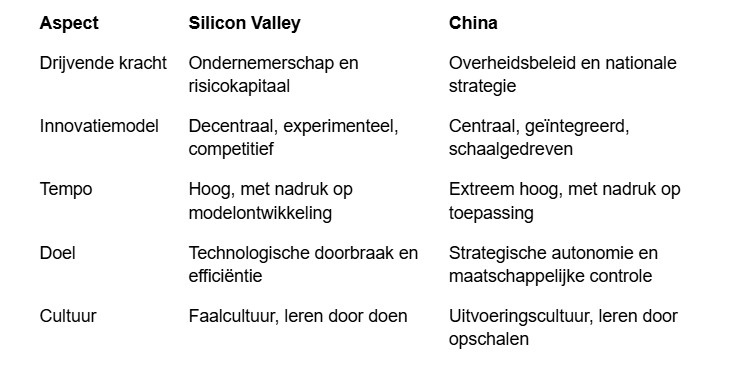
Both models produce impressive results. But they also highlight each other's weaknesses:
- In Silicon Valley, speed can lead to rushed implementations and ethical blind spots.
- In China, centralization can stall innovation and suppress creativity.
And the Netherlands? A country between ambition and hesitation
The Netherlands finds itself in an awkward middle position. We possess talent, infrastructure, and knowledge, but lack focus and pace. We have the creativity of Silicon Valley, but not the investment rhythm.
We have the organizational power of China, but not the decisiveness. The consequence is that AI here often gets stuck in pilot projects, strategy consultations, and policy documents. Real scale, where AI transforms processes, companies, and sectors, remains elusive. The core question is therefore not if the Netherlands can participate, but if we dare to choose. Choosing a direction, a vision, a national ambition that goes beyond isolated initiatives.
What we can learn from both worlds
1. From Silicon Valley: Dare to accelerate
Innovation requires freedom, not permission. The Netherlands must create the space to experiment, make mistakes, and learn.
Fast iteration is the engine of progress.
2. From China: Dare to scale
Good ideas die in the pilot phase if there is no policy or infrastructure to scale up.
The Netherlands has strong knowledge institutions and companies, but lacks an integrated system where government, business, and education move forward together.
3. From both: Dare to steer
AI should not just be a technological project, but also a societal compass.
We must determine what we want to use AI for: not just for efficiency, but for broad progress.
The strategic lesson for the Netherlands
The AI revolution will not wait until we are ready.
China builds for scale, Silicon Valley builds for speed, and both are building for future leadership.
If the Netherlands wants to remain relevant, we must combine the unique strengths of both worlds:
- The agility and innovation culture of Silicon Valley.
- The coordination and scaling power of China.
That requires vision, courage, and collaboration. Not waiting until it is "safe" to experiment, but taking the leap right now. Because the future of AI will not be written by the fastest or the largest, but by those who dare to act with the most purpose.

// About the author
Job van den Berg
Mede-oprichter, AI Keynote Spreker & Techondernemer
Tech-ondernemer (1989) met een achtergrond als socioloog (Research Master (MSc) in statistiek en sociologie) en een van de meest gevraagde keynote sprekers over AI en data in Nederland. Als mede-oprichter van Ai.nl, The Automation Group en Proxies leidt hij engineers die agentic AI van prototype naar productie brengen binnen enterprises. Op het podium vertaalt Job die hands-on praktijk naar concrete strategieën. Eerder was Job Chief Data bij o.a. DPG Media en Kantar. Hij is co-auteur van 5 boeken over AI waaronder 'AI Agents' en 'Handboek AI Strategie' en een veelgevraagd expert in de landelijke media.
LinkedIn