Stop Playing Digital Twister: The Rise of the AI OS
We play digital Twister moving between SaaS tools all day. The solution is not more AI tools, but one central AI OS. Here is why the app stack will collapse.

At the office, we basically play a game of digital Twister all day long.
Right hand on red. Open your email. Left foot on blue. Open an Excel file. Right foot on yellow. Look something up in the CRM. Left hand on green. Pull a document from SharePoint. Then you twist your back to jump into Teams and message a colleague.
You repeat this exhausting cycle dozens of times a day.
AI has definitely made a lot of our work faster. You can write emails in seconds or summarize a long PDF instantly. But fundamentally, we are still moving from tool to tool. The underlying problem remains. That is why I believe the next big step for businesses is not buying more separate AI tools. The next step is establishing one central point of contact.
From tool-hopping to one point of contact
Most companies treat AI as a shiny new feature. They add an AI button to their word processor. They buy an AI assistant for their CRM. They implement an AI chatbot on their intranet.
The result? Employees are still hopping between applications. The digital Twister game continues, just at a slightly higher speed. It creates immense cognitive load. You constantly have to switch context.
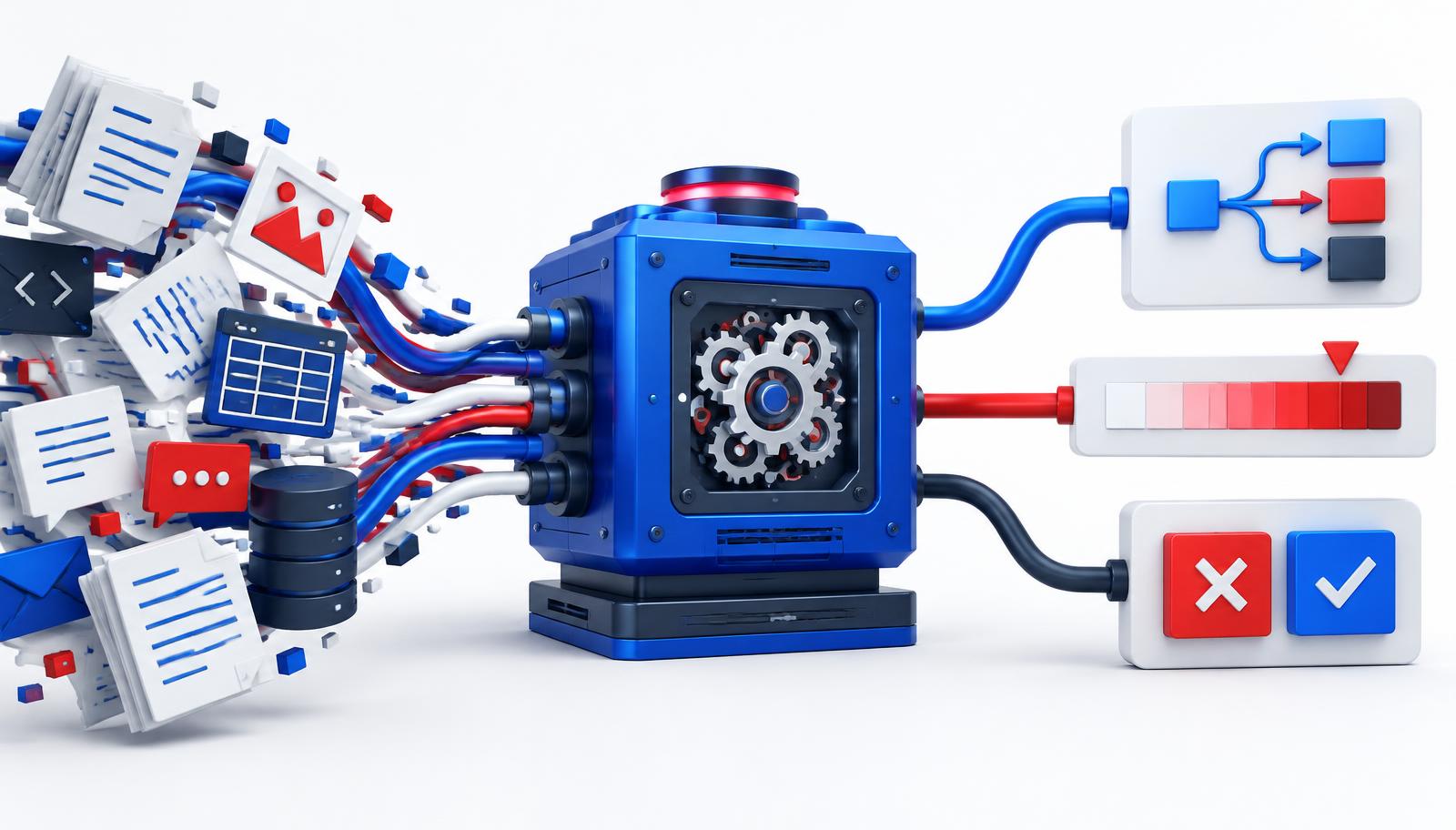
True productivity does not come from working a little faster inside isolated silos. It comes from removing those silos entirely. We need a fundamental shift in how we work. We must move from fragmented software to a unified interface. Think of it as an AI Operating System. You talk to one central entity, and it does the heavy lifting across all your different systems. You tell it what you need. It figures out where to go, what tool to use, and how to get it done.
Roberto: our own AI Operating System for the radio show
We do not just talk about this at ai.nl. We build it ourselves.
For our radio show, we created our own AI Operating System. We call him Roberto. Roberto is a single AI agent that knows all our playbooks, formats, and processes inside out.
He acts as our only point of contact. But underneath the hood, Roberto is an orchestrator. He manages several other specific agents and software systems in the background. If we need to prepare an episode, we do not open five different tabs. We do not waste time searching for where specific information or audio clips live.
We just communicate with Roberto. He distributes the tasks to the right tools, pulls the necessary data, and delivers the final script.
Working like this feels fundamentally different from juggling separate AI tools. There is significantly less tool-hopping. There is a lot more focus on the actual creative work. For us, this is the practical, everyday reality of using AI as an Operating System.
Why the SaaS stack is under pressure
This idea is gaining serious traction across the entire tech industry. The leaders of the biggest software companies in the world see this transition coming. They are actively preparing for it.
Take Satya Nadella, the CEO of Microsoft. In late 2024, during the BG2 podcast with investors Bill Gurley and Brad Gerstner, he made a striking prediction. He stated that the classic business application stack, the world of SaaS as we know it, is going to "collapse." His reasoning was simple. AI agents will absorb the business logic that currently lives inside dozens of separate applications. The agent becomes the new interface.
We see the same vision at ServiceNow. During their Knowledge 2025 keynote in May 2025, the company explicitly positioned itself as "the AI operating system for the enterprise." Their CEO repeated the same hard truth: "the traditional app stack will collapse." Software vendors are racing to become the invisible plumbing behind your central agent.
What this means for your organisation
Should you cancel all your software subscriptions tomorrow morning? Absolutely not. But the shift from fragmented applications to a central AI layer has already started. If you do not want to be caught off guard, start with these practical steps today:
- Stop accumulating tools: Critically review your current subscription stack. Does every small business process really need its own dedicated user interface, or could a smart AI handle the task through an API in the background?
- Document your processes: An AI agent is powerful, but it is not psychic. Our agent Roberto only works because our radio show workflows are documented in extreme detail. No agent functions without a clear process behind it.
- Start small and experiment: Build a simple internal orchestrator agent for one specific team. Let people experience how much energy they save when coordination work is taken off their plate.
- Prioritise data quality over UI polish: If your future interface is just a chat window or a voice command, the underlying data is everything. Clean up your SharePoint, your CRM, and your file storage now. A great agent cannot fix a messy data foundation.
The era of contorting yourself into uncomfortable digital positions at work is coming to an end. The real value of AI is moving silently under the hood. Anyone who keeps investing in more separate applications with their own login screens will soon be playing a lonely, pointless game of Twister.

// About the author
Job van den Berg
Mede-oprichter, AI Keynote Spreker & Techondernemer
Tech-ondernemer (1989) met een achtergrond als socioloog (Research Master (MSc) in statistiek en sociologie) en een van de meest gevraagde keynote sprekers over AI en data in Nederland. Als mede-oprichter van Ai.nl, The Automation Group en Proxies leidt hij engineers die agentic AI van prototype naar productie brengen binnen enterprises. Op het podium vertaalt Job die hands-on praktijk naar concrete strategieën. Eerder was Job Chief Data bij o.a. DPG Media en Kantar. Hij is co-auteur van 5 boeken over AI waaronder 'AI Agents' en 'Handboek AI Strategie' en een veelgevraagd expert in de landelijke media.
LinkedIn